A production-ready optical test platform for microLED devices
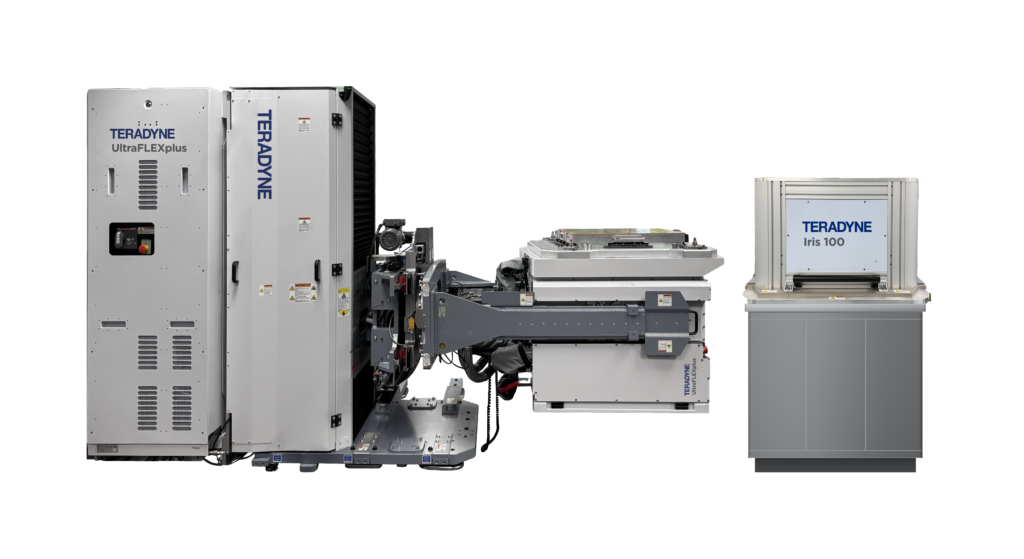
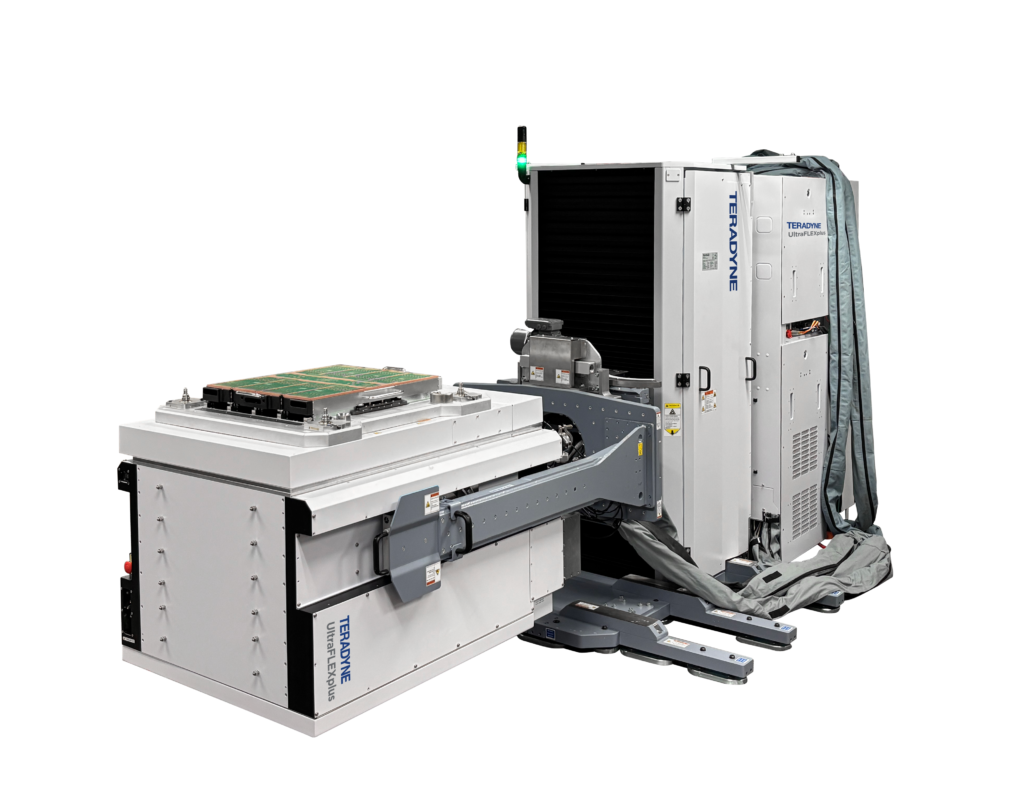
By measuring every individual emitter in an array and integrating directly with Teradyne UltraFLEXplus platform for combined optical and electrical test, Teradyne Iris 100 brings semiconductor-grade optical test to microLED manufacturing. Iris 100 supports wafer and final test, letting manufacturers add optical test to fleets they already run.
Per-Emitter Optical Test
Measures every individual emitter in an array with production-level precision and throughput.
Integrated Optical & Electrical Test
Integrates directly with Teradyne UltraFLEXplus test systems for combined optical and electrical test.
Spectral and Per-Pixel Measurement
A spectrometer and high-resolution camera measure spectral response of the array, and per-pixel luminance and uniformity.
High-Throughput Array Characterization
Advanced test parallelization and image-processing algorithms enable characterization of a full microLED array with high throughput.
Early Optical Defect Detection
Leveraging Teradyne’s widely-adopted IG-XL software, Teradyne Iris 100 detects optical defects such as dead/stuck pixels and cluster defects early in the manufacturing process.
Absolute, Correlated Measurement
Its NIST-traceable calibration workflow enables absolute measurements that correlate lots, wafers, and manufacturing sites.
Applications
- Augmented Reality Microdisplays
- Optical Data Interconnects for AI Data Center Architectures
Semiconductor-Grade Optical Test for MicroLED Manufacturing
Leverages Teradyne UltraFLEXplus platform and IG-XL to deliver production-level optical test for microLED devices
Supports wafer and final test, with a roadmap to support photodetector test capabilities in the same insertion
As the leading provider of complete test cell solutions and services, Teradyne leverages its expertise, experience, and technology leadership to help our customers achieve the highest yield and throughput in production, with the fastest time to market. We partner with you in your journey from design to production to provide standard and customized test cell products and services.
The World’s Leading Semiconductor Test Platform
The UltraFLEXplus combines new instrument and software capabilities with a revolutionary tester infrastructure that provides a step-function improvement in throughput and engineering efficiency – all while leveraging the cumulative test IP developed over the UltraFLEX’s long history.
Fastest Time to Production
IG-XL software compatibility and the new Broadside Applications Interface enables test engineers to be more productive from the start and reduce the time to production by more than 20%.
Highest Throughput
The new UltraFLEXplus architecture increases site counts and improves parallel test efficiency, increasing overall throughput and reducing the number of test cells required by 15%-50%.
Scalable Architecture
The UltraFLEXplus can be redeployed for multiple product lines and upgraded for future product requirements, increasing reuse and extending the asset’s useful life.
Applications
- Mobile Application Processor
- Digital Baseband Processors
- High Data Rate RF Transceivers
- RF Connectivity Devices
- mmWave
- 5G
- Mobile Power Management ICs (PMIC)
- Microprocessors
- Network Processors
- High Speed SERDES (SERializer/DESerializer) and Backplane Transceivers
- Storage Controllers
- High-end Microcontrollers
- Audio and Video Processors
Configurations
The UltraFLEXplus has 3 base systems that allow customers to optimize capital cost, floor space and maximum resource count. All three versions utilize the Broadside DIB for higher density, higher site counts, and simplified routing.
UltraFLEXplus Q24
24-slot system
UltraFLEXplus Q12
12-slot system
UltraFLEXplus Q6
6-slot system
Suite of New High Performance Third Generation Instruments
UltraPAC300 – Next Generation High Density Analog Instrument
- High performance audio and baseband AC instrument
- Coverage up to 300MHz
- Dual mode high speed and high-resolution channels
UltraCTO384 – High performance, High Density Converter Test Option
-
128 source channels, 128 capture channels, and 128 reference channels
-
Single ended and differential embedded converter test up to 16 bits of resolution
-
Sine and smooth ramp generation for at-speed testing
-
+/-50uV voltage measurement accuracy for device trim
-
DUT voltage sense for both source and reference
-
Integrated source to reference calibration minimizes DIB circuitry requirements allowing for high sitecount
Image Capture Instruments
UltraSerial20G – Next Generation, High-speed Serial Image Capture Instrument
UltraVS64-HP – Advanced Core Power Supply Instrument
- 1,280 Amps of device power per instrument
- Merge up to 5,120A for a single ganged supply
- Total test cell capacity exceeding 15,000 Amps
- Unique 16V range for emerging integrated voltage regulator (IVR) architectures
- Integrated multi-point sense with superior dynamic load response across reticle-size die and multi-die packages
- Intelligent power interface with hardware-level fault response against thermal runaway
UltraVS64 – Core Power Supply Instrument
- Extremely accurate, stable resource for device core supplies
- Unmatched dynamic performance
- <1mV 6 Sigma voltage accuracy
- Up to 320 Amps of device power per instrument
- Merge up to 1,600A for a single supply
- Supports instantaneous system-wide current steps of up to 2,560 Amps
UltraVS256-HP – High Density, Highly Flexible General-purpose Device Power Supply
- 256 channels per instrument
- Flexible merge capability
- Excellent dynamic performance
- Low noise
- Four quadrant voltage or current source and measure
UltraVI264 – High Precision, High Density DC Instrument
- 104 low voltage channels muxed to 248 connections
- 8 high voltage channels muxed to 16 connections
- Flexible channel merge for USB charging standard
- High precision DC measurements
High-Speed I/O (HSIO) Instruments
UltraPort-PCIe6 – High-Speed I/O Protocol Instrument for PCIe Gen6 Devices
- 64 Gb/s (PAM4) across 32 lanes per instrument
- Unique per-pin PMU and integrated loopback for enhanced coverage and diagnostics
- Excellent signal integrity with the cleanest signal path to the device
- Dedicated server-class compute backend scaling to 2TB of high-performance memory
- Mission-mode testing and high-speed I/O scan shift coverage to earlier insertions for Known Good Die
UltraPHY: Complete PHY Performance Test Coverage
UltraPHY 224G
- 8 full-duplex differential lanes + 8 Rx-only differential lanes per instrument
- Test data rates up to 112 Gb/s NRZ and 224 Gb/s (112 Gbaud) PAM4
- High density at extreme data rates; supports multiple instruments per UltraFLEXplus tester
- Coexists with other industry-leading UltraPHY instrument variants on UltraFLEXplus
- DSO + BERT architecture for comprehensive PHY production test and characterization
- Unified workflow via Teradyne’s widely adopted IG-XL software
- Supports most eye-related measurements for PAM4 and NRZ, such as height, width, TDECQ, etc.
- Example use cases: PCIe Gen 7, OIF CEI-224G, CXL, Silicon Photonics (SiPHO), and more
UltraPin5000-EM – Advanced Digital Instrument
- Purpose-built for pattern-intensive AI and compute devices
- Up to 80x more vector memory than other market offerings
- Up to 10x faster pattern loads; Persistence Mode for near-instant reloads
- Flexible timing architecture supporting independent clock frequencies per pin
- Scan network acceleration for real-time per-core results and adaptive test decisions
- Compatible with the UltraPin2200, protecting existing test IP investments
UltraPin2200 – High Density Digital Instrument
- High density, 512 channels per instrument
- 32 pattern generators per instrument for concurrent test or unique pattern flows per site
- Proprietary, hardware-based protocol aware capability
- Dedicated memories for non-deterministic data testing
- Up to 16Gbit scan test capacity with a flexible pattern memory architecture
- Data sharing across sites
UltraPHY 112G
- 16 full-duplex differential lanes
- Test data rates up to 64 Gb/s NRZ and 112 Gb/s (56 Gbaud) PAM4
- High density; scales to multiple instruments per UltraFLEXplus tester
- Coexists with other industry-leading UltraPHY instrument variants on UltraFLEXplus
- AWG + DSO architecture for comprehensive PHY production test and characterization
- Unified workflow via Teradyne’s widely adopted IG-XL software
- Enhancement path to UltraPHY 224G, future-proofing the investment
- Supports most eye-related measurements for NRZ and PAM4, such as height, width, SNR, etc.
- Example use cases: PCIe Gen 1- Gen 6, OIF CEI-112G, IEEE 802.3ck Ethernet, Silicon Photonics (SiPHO), and more
UltraWave8G & UltraWave24G – High Speed, High Performance Next-Generation RF Instruments
- 8 independent sources and 8 independent receivers per instrument
- 32 bi-directional ports per instrument
- Frequency coverage from 50 MHz to 24 GHz
- State of the art error vector magnitude (EVM) and phase noise performance
- Configurable to offer optimized performance and cost of test
UltraPAC500 – High Bandwidth Analog Baseband RF Instrument
- 500 MHz I/Q bandwidth support
- 16 differential source and 16 differential capture channels per instrument
- Excellent error vector magnitude (EVM) performance with -50 dB typical for WiFi 7
- Per pin parametric units (PPMU) function
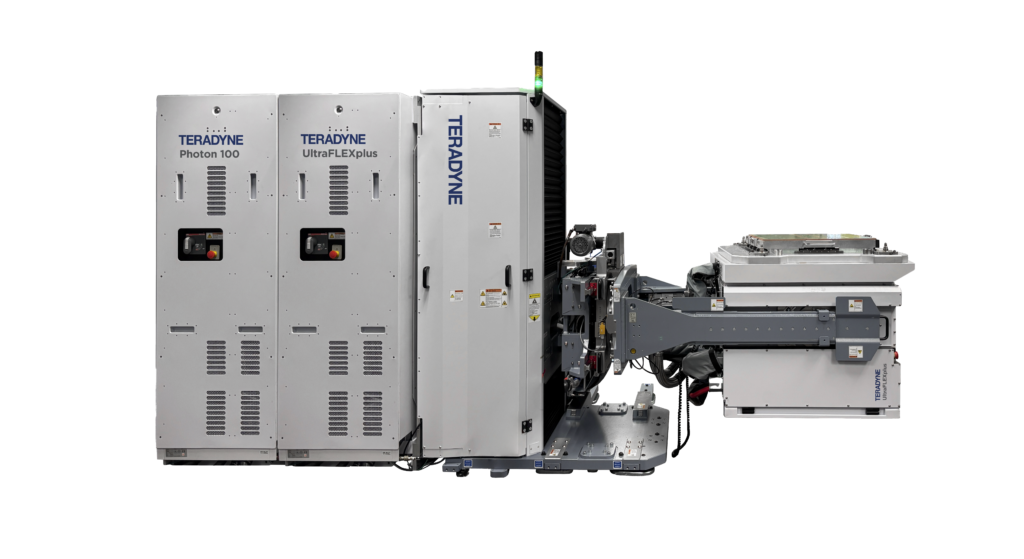
By integrating advanced optical and electrical instrumentation with the UltraFLEXplus platform, the Teradyne Photon 100 delivers high-throughput, automated testing across wafer, optical engine, and co-packaged module stages. This streamlines operations, accelerates time-to-market, and supports scalable silicon photonics manufacturing
By combining a precision optical stack with six-axis fine alignment, the Teradyne Iris 100 delivers accurate, absolute optical measurement of microLED devices at production throughput. Absolute measurement correlates results across test cells, turning production test into process control as microLED volumes scale.
Leveraging our customers’ existing investment, the UltraFLEX family of testers strives to reduce the engineering effort required to develop and deploy new test programs with comprehensive instrumentation and our IG-XL software, an industry standard with over 10,000 active programmers that has been continually enhanced over UltraFLEX’s long history.
As the leading provider of complete test cell solutions and services, we at Teradyne leverage our expertise, experience, and technology leadership to help our customers achieve the highest yield and throughput in production with the fastest time to market. We partner with you in your journey from design to production to provide standard and customized test cell products and services.
Guardian
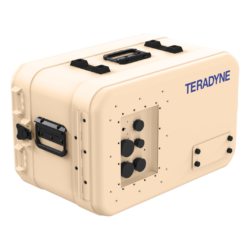
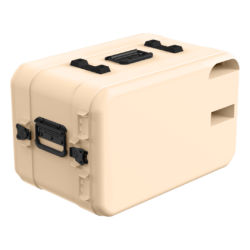
Portable, O-Level ATE Platform
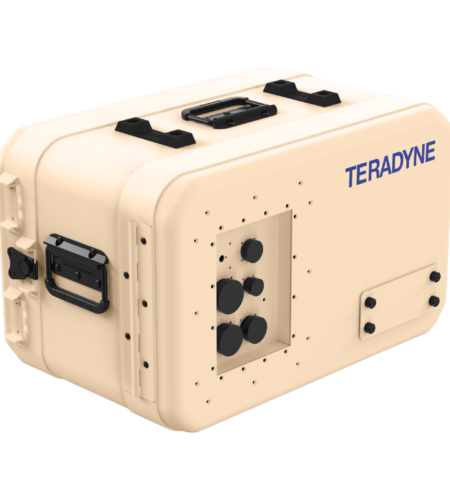
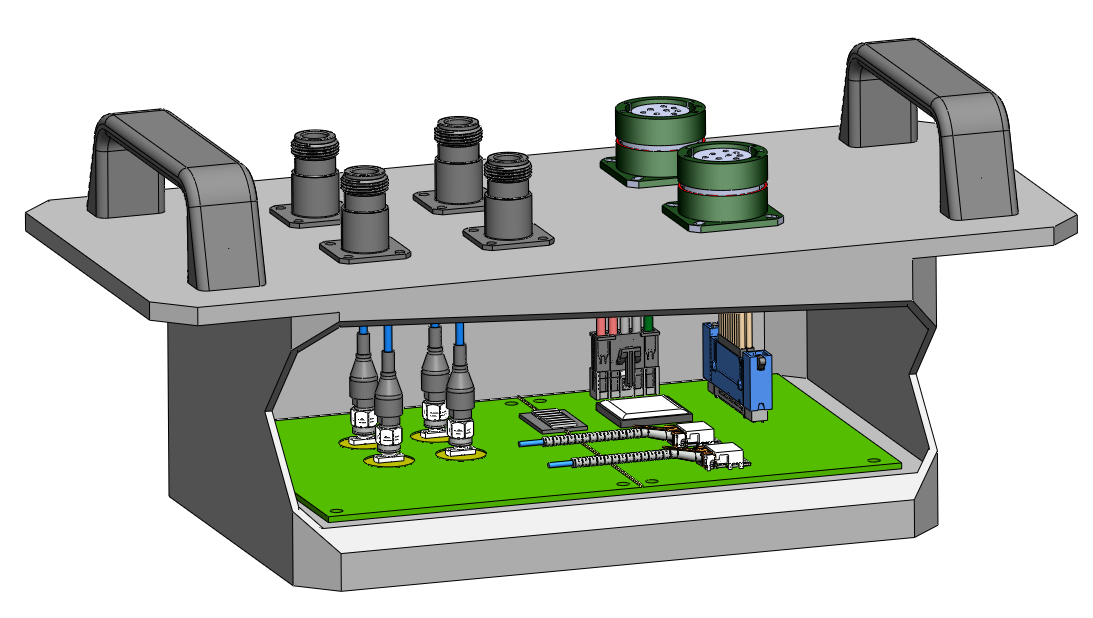
Guardian is a ruggedized automated testing platform that quickly and accurately verifies the operational readiness of complex electronics systems in aircraft, ships, and vehicles.
With its standards-based, reconfigurable architecture, Guardian supports a wide range of applications including electronic combat, communication, navigation, avionics, and control systems. The flexible design addresses rapidly evolving test requirements and allows for cost-effective long-term sustainment.
Highly Reconfigurable Architecture Supports Wide Ranges of Field Test Applications
Guardian’s architecture provides three levels of reconfigurability.
- Hardware: Guardian supports up to four PXIe instruments, either reconfigurable or standard, providing endless test application possibilities.
- Interfaces: Guardian’s physical I/O panel can be configured to support a wide range of UUT interfaces.
- Software: Guardian’s software infrastructure and test program interfaces can all be configured using open software environment.
Guardian is an ideal solution for a multitude of O-Level test requirements in a single and secure package. Its ruggedized enclosure can operate in the harshest environments and meets the requirements for single person lift. The ergonomic design allows for easy handling and operation while the modular design provides hassle-free maintenance.
- Military operational-level testing
- Mission readiness verification at shipboard, airfield, forward operating base
- Commercial aerospace flight-line testing
- Data loading, operational, and functional tests
Can be configured to support a wide range of test applications.
Software defined, reconfigurable architecture to test requirement changes and future technology updates.
Compliant with MIL-PRF-28800, MIL-STD-810, and MIL-STD-1472 allowing use in the harshest environments.
The chassis and internal FRUs are accessible from the front and back, allowing users to easily maintain the system.
Guardian is supported by Teradyne product support and services, assuring cost-effective long-term deployment.
Mechanical
-
- Transportable system enclosure: Aluminum, Color Desert Tan – AMS-STD-595 Color 33446, Tie Down Handles, Mounting Feet
- System Dimensions (LxWxH) 15”x25”x16”
- System weight < 48 lbs. single person lift
Computer
- Secure Windows Operating System
- Storage 32GB DDR4 RAM, 500GB Solid State Drive
- Secure computer I/O
Input Power
- 24V – 28V DC or 115V AC, 60Hz – 400Hz
Omnyx
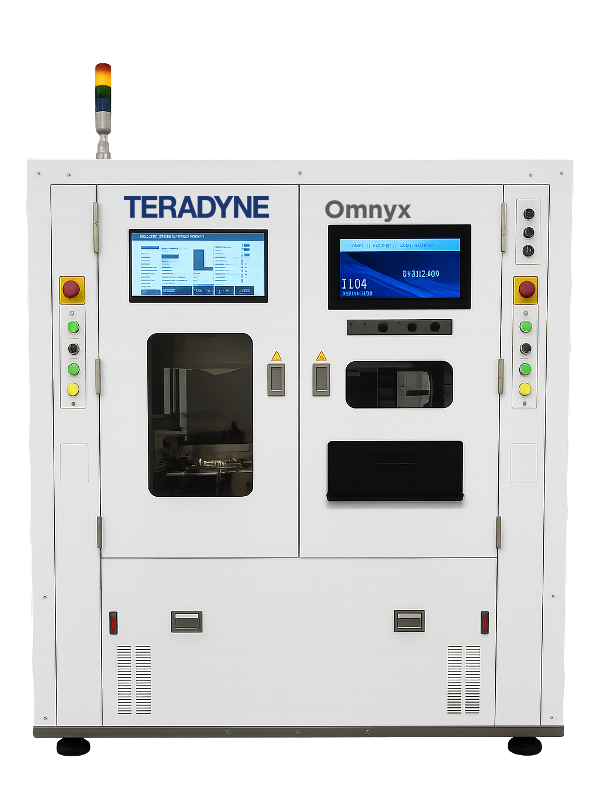
Advanced Test Platform for AI and Data Center PCBA Manufacturing
Omnyx is an advanced manufacturing test platform for printed circuit board assemblies (PCBAs) and sub-assemblies used in AI and data center hardware. By integrating structural, parametric, high-speed interconnect, and operational testing within a single platform, Omnyx enables manufacturers to test both assembly integrity and system performance earlier in the manufacturing process.
As AI and data center architectures evolve, PCBAs and sub-assemblies are becoming increasingly complex and valuable. Conventional in-circuit test (ICT) methods primarily detect structural and parametric defects introduced during assembly. However, many issues affecting modern high-performance systems, including signal integrity and operational faults only appear under high-speed or mission-mode conditions.
By expanding test coverage beyond traditional ICT, Omnyx enables manufacturers to detect these defects at the component and sub-assembly stage before final system integration. This approach helps reduce defect escapes, improve end-of-line yield, and ensure the quality and reliability required for today’s high-performance data center infrastructure.
Expanded Test Coverage
Combines structural, parametric, high-speed interconnect, and operational testing in a unified platform
Earlier Defect Detection
Identifies signal integrity and performance issues at the component and sub-assembly stage
Improved Yield and Quality
Reduces defect escapes and improves final system reliability
Optimized for AI and Data Center Hardware
Designed for complex, high-performance compute architectures
Scalable Manufacturing
Supports economically scalable production for next-generation infrastructure
- Automation: No-touch high-speed conveyance, SMEMA ready
- Test System: Synchronized Analog and Digital Subsystems
- Compatible Test Architecture: Single site, multi-site and large format
- Pin Capacity: 2,560–10,000+ pins
- Fixture Compatibility: Automated/manual single-fixture hardware
- Controller: Windows 10/11® Pro PC
- Interface: Integrated mouse/keyboard, monitor
- Networking Interface: Ethernet
- Industry Standard Safety Compliance
A comprehensive opto-electric automated test platform purpose-built to accelerate high-volume silicon photonics and co-packaged optics manufacturing.
By integrating industry-leading optical and electrical instrumentation with Teradyne’s proven UltraFLEXplus platform, the Teradyne Photon 100 enables high-throughput, automated testing of silicon photonics across all key manufacturing stages, including wafer, optical engine, and co-packaged module insertions. This solution simplifies operations, accelerates time-to-market, and enables rapid scaling for silicon photonics and co-packaged optics manufacturing.
Integrated Optical & Electrical Instrumentation
Combines advanced optical and electrical test capabilities within the Teradyne UltraFLEXplus.
Comprehensive Test Coverage
Supports wafer (single and double-sided), optical engine, and CPO test insertions.
Operational Simplicity
Designed, built and maintained by Teradyne, eliminating the need for customers to integrate and support multi-vendor solutions.
Scalable Architecture for High-Volume Manufacturing
Designed to support the rigorous demands of high-volume SiPh and CPO production environments
Customizable Optical Instrumentation
Standard configuration available, with the ability to tailor optical instrumentation to meet specific customer needs.
Open Ecosystem
Customers can choose their preferred test cell ecosystem partners for high-volume manufacturing.
Applications
- Pluggable Transceivers
- Optical Engines
- Switches with Co-Packaged Optics
- AI Accelerators with Co-Packaged Optics
Test Insertions
- Wafer Test
- Package Test
- Module Test with Co-Packaged Optics
UltraFLEXplus Q12
12-slot system
Double Sided Wafer Probe Test Cell for Silicon Photonics
Leverages UltraFLEXplus and IG-XL to deliver high volume silicon photonics wafer test for growing co-packaged optics (CPO) demand
Delivers production level test for hybrid bonded photonic integrated circuit (PIC) and electronic integrated circuit (EIC) wafers
As the leading provider of complete test cell solutions and services, Teradyne leverages its expertise, experience, and technology leadership to help our customers achieve the highest yield and throughput in production, with the fastest time to market. We partner with you in your journey from design to production to provide standard and customized test cell products and services.
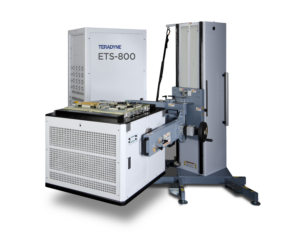
Next-generation Automotive Test Platform with the Industry’s Highest Throughput and Fastest Time to Market
The ETS-800 is designed with comprehensive functional test coverage including extensive analog and digital capability and provides automotive-level test quality. Its unique APEX architecture minimizes DIB complexity, reducing time from project start to production release and enabling high site count to ensure sustainable high throughput.
Scalable Site Count
- Unique Multi-sector Architecture
- Enables near-zero effort program scalability to high site count.
- Supports up to four sectors, typically configured in a symmetrical fashion to enable site count scalability up to 1024 total sites.
- Fast and easy capacity expansion when device volumes increase with support for a wide range of site counts and easy upgradeability to higher site counts
Highest Throughput
- Fast PCIexpress communication infrastructure, optimized API’s and extensive test time profiling tools result in the shortest test times in the industry
- Multi-sector Architecture delivers high parallel test efficiency with no effort from the test engineer
- The largest applications space available, plus the APEX architecture’s integrated matrices & muxes enables maximum site count.
Fastest Time to Market
- Mature, stable & powerful EV-MST Software enables test engineers to develop test programs efficiently.
- Multi-sector Architecture allows engineers to focus on single or low site count program development and scale to a high site count program with near-zero effort. High parallel test efficiency is achieved automatically.
- The APEX architecture reduces relays by an order of magnitude, enabling simpler dibs, higher site count and shorter development times.
Automotive-level Test Quality
- Precision instrumentation and conservative, guaranteed specifications deliver stable results that are repeatable from tester to tester and device to device.
- Comprehensive, integrated alarm infrastructure ensures every device pin receives the intended stimulus.
Industrial Power Management
- Smart power stages, low dropout regulators, DC-DC converters, voltage regulators, boost regulators, mult-phase PWMs, battery chargers, hot swap power managers, gate drivers
Precision Analog
- Op amps, instrument amplifiers, video amplifiers, audio amplifiers
Automotive Analog
- BMS monitors, fuel injectors, ABS controllers, airbag controllers, automotive smart switches, CAN transceivers, motor drivers
Mobility
- USB chargers, wireless chargers, PMICs
The ETS-800 test platform is designed with a unique Multi-sector Architecture making the system inherently scalable in terms of site count, with up to 1024 total sites. The system supports up to four sectors and each sector represents a complete mixed-signal multisite test system capable of testing a wide variety of products.
Production systems are controlled via a single multi-core test computer and may be populated with one, two, or four sectors based on the desired maximum site count. Engineering systems support simultaneous, independent multi-engineer development.
ETS-800 D40
Max Four Sector, 40-slot system
ETS-800 D20
Max Two Sector, 20-slot system
HSD-64 Performance Digital
- 64 channels
- Data rate 200MVps
- -2V to +12V, 32mA PPMU
UPD-64 Universal Digital / VI
- 64 channels
- Data rate 20MVps
- -1V to +24V, 50mA PPVI
- APEx 4 Dual 2-by-8 force/sense DC matrices
- Supports -80 to +120V, 1A DC / 4A pulse
APU-32A Floating Low Power VI
- 32 VI channels
- -30V to +80V, 200mA VI
- Src/Cap/AWG per channel
- APEx 4x 2×8 matrices w/4A pulsed operation
SPU-8112 Floating High Power VI
- 8 high bandwidth VI channels
- +/-100V, 2A DC, +/-12.5A pulse per channel, gangable to 100A
- 20bit audio source & capture
- APEx: A/B output mux
SPU-500 Floating High Voltage VI
- 2 VI channels
- +/-500V, +/-50mA per channel
QMS Precision Digitizer
- 4 precision differential VMs
- 12-bit at 10 Msps or 16-bit at 200 ksps
- +/-200V floating
QHSU High Speed AC
- 4 160 Msps sources
- 4 80 Msps digitizers
- 2 50 MHz dual channel signal analyzers
SPMB-200 SPU Booster/MUX
- APEx 16x 1×4 200V muxes, 2A matrices, 12.5A pulse
MCMUX Mux Family Board
- APEx 64 1×4 200V 2A Muxes, 12.5A pulse
The ETS software development environment and tool set are truly one of the strongest attributes of the ETS-800 test system. The software tools are easy to learn and use, and are fully integrated into the Microsoft Visual Studio development environment. The complete test system command set is supported with automatic code generation tools (ACE™ and GrACE™). This means that users are not required to memorize command arguments and syntax. Graphical plotting tools are provided for simple point-and-click plotting of test-oriented waveforms. RAIDE™ (Rapid Access Interactive Debug Environment) makes it easy to view and change tester hardware settings.
In addition to native MST development tools a comprehensive portfolio of productivity tools – designed for applications engineers, by applications engineers, are available to enable efficient program development.
ETS-800 software provides a robust test development environment, offering customers an easy learning curve and uncommon productivity. With Multi-sector technology, EV-MST allows users to replicate test programs across multiple test head sectors.
Key Features
- Simultaneous independent applications in engineering mode
- Up to 4 engineers can develop independent test program simultaneously
- Nearly 100% multisite efficiency across sectors with zero applications effort
As the leading provider of complete Test Cell Solutions and services, we at Teradyne leverage our expertise, experience, and technology leadership to help our customers achieve the highest yield and the highest throughput in production with the fastest time to market. We partner with you in your journey from design to production to provide standard and customized test cell products and services.
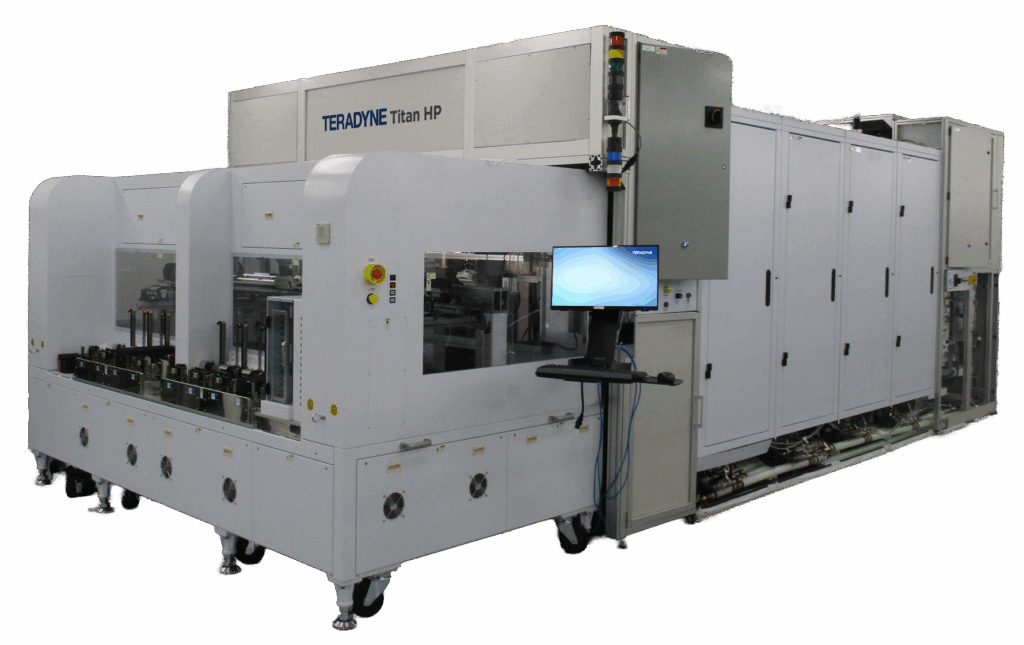
Titan HP
Leading System Level Test Platform for AI and Cloud Infrastructure Devices
Teradyne Titan HP is the leading, high-performance system level test (SLT) solution, enabling mission mode testing for next-generation AI and cloud infrastructure devices. As part of Teradyne’s comprehensive portfolio of test equipment, which delivers superior tests for every device across every insertion, Teradyne Titan HP ensures that our customers’ capital equipment investments are future-proofed for tomorrow’s evolving market demands.
Production Proven Solution
The Teradyne Titan™ HP System Level Test (SLT) platform, deployed in production at multiple customers, delivers optimal flexibility, scalability, and density in semiconductor test environments that demand the highest levels of system performance testing. This platform is particularly suited for AI and cloud infrastructure devices, which necessitate efficient thermal control due to their significant power consumption and heat dissipation challenges. With advanced active thermal control (ATC) features, the Titan HP is designed to prevent overheating and burnout while optimizing test time and flow, making it a critical solution for AI and cloud infrastructure SLT applications.
Key features of the Titan HP include:
- High per device kW power delivery, with a roadmap that supports ever-increasing market requirements.
- Superior per-site thermal control customized to individual device requirements for thermal and force zones.
- Atlas SLT software platform that enables users to import existing or create new SLT test programs. Test programs can then be edited or ported to other Teradyne SLT systems.
- An asynchronous slot architecture that optimizes OEE.
- Support for the ability to shift tests between ATE and SLT.
- Superior applications and support services to ensure customer success.
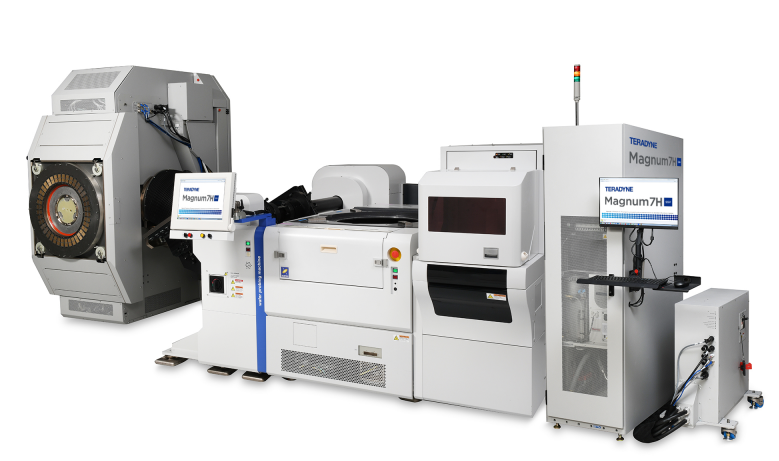
Advanced High Bandwidth Memory Test Platform to Support Next-generation AI Applications
With the proliferation of AI, high–bandwidth memory (HBM) has become an integral part of AI processors due to its ability to handle the massive data processing and complex computations required by modern AI models. Teradyne’s Magnum 7H platform delivers industry-leading speed and parallel test efficiency for HBM. With advanced memory and logic testing capabilities, these systems support critical test stages of the HBM manufacturing process—from base die wafer test to pre-singulated HBM test to post-singulated HBM test—including memory core testing and speed validation.
High Performance
Supports data rates up to 4.5 Gbps with high-speed tester interface units (TIUs), enabling speed testing of current HBM3/3E and next-generation HBM4/4E devices.
High Parallelism
Configurable for up to 9,216 digital pins and 2,560 power pins to maximize parallel throughput in mass production environments.
Proven P52 Probe TIU
Leverages the field-tested Teradyne P52 probe TIU, currently deployed in hundreds of Magnum production systems worldwide.
Comprehensive Logic Testing
- Supports at-speed memory testing with a flexible algorithmic pattern generator (APG).
- Supports at-speed logic testing and deep Logic Vector Memory (LVM) option.
- Features Fail List Streaming (FLSTM) for at-speed error capture for both memory and logic testing.
- HBM base die wafer test
- Pre-singulated HBM (stacked dies on base wafer) test
- Post-Singulated HBM (stacked dies) test
Magnum 7H SSV
- Configurable up to 9,216 digital pins and 2,560 power pins
- Power pin with 1.2A or 2A options
- Speed options up to 4.5Gbps
- Logic Vector Memory (LVM) options
Probe TIUs
- The Magnum 7H leverages Teradyne’s P52 wafer sort interface used across multiple Teradyne platforms.
Calibration Kit
- Includes a dedicated probe interface check and DxCal board, designed for Teradyne’s P52 TIUs. Once calibrated, the system matches the reference tables to the customer-specific probe cards mounted on the TIU.
Magnum 7H utilizes interoperable Teradyne test development and debug tools, enabling seamless collaboration across Magnum platforms. Test programs are developed once for a site testing one or more devices, then automatically cloned to all applicable sites on the tester, streamlining the entire process. The debug suite is site-aware, making it easy to isolate issues at the device level and ensuring a smooth transition from new product introduction to high-volume manufacturing.
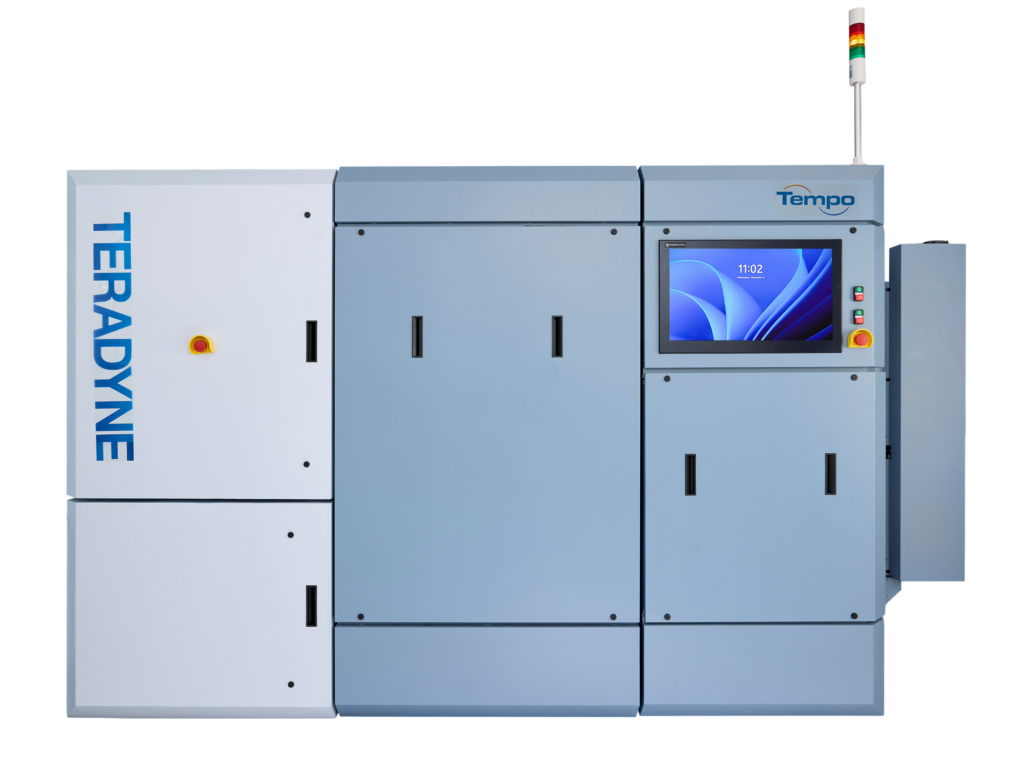
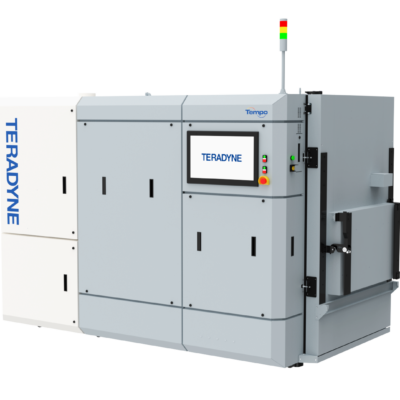
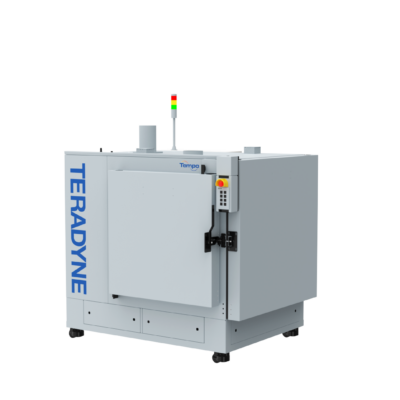
Tempo
Automated, Scalable Thermal Test Solution for Factory Applications
Tempo is a NextGen thermal test system that incorporates automation to enable reliable high-volume CCA testing using fewer test resources. Tempo delivers 3x higher throughput over traditional thermal test chambers by incorporating automation and minimizing tester idle time.
The Tempo Product Line includes solutions to meet the full spectrum of Factory Test needs from Engineering Development & Debug (Tempo Workbench), to Low-Rate Initial Production (TempoOne), to Full Rate Production (Tempo). Tempo integrates with a wide variety of Testers, including all Spectrum variants, and Tempo can be integrated with Factory Automation to support evolving test needs.
- Factory applications that require Functional Testing of CCAs at thermal extremes
- High-Volume Thermal Testing of Defense & Aerospace products (i.e. – missiles & munitions)
- Scaling test capacity over Product Lifecycle from Development, to LRIP, to Full-Rate Production
- Automating thermal testing to increase efficiency and reduce costs
- Integrating existing 3rd Party Testers with scalable thermal test solution
Tempo System Configuration Components
Thermal Controller
- 30kW Heating Element
- Proportional LN2 Injection with redundant Safety Solenoid w/ optional GN2 inlet (or CDA)
- Temperature Range: -55 to +85 (±2C)
- Adjustable Ramp Rate: 15C/min (max)
- Airflow: 1500-1600 CFM throughout chamber
- Conditioned Air delivered to UUTs via focused ducts to promote efficient thermal transitions
Automated Conditioned Environment
- Gantry, Transition Rack, and Test Site Actuator
- Optimized, sealed and reinforced thermal enclosure
- Separable from Thermal Controller
Automation Ready
- Interfaces with a range of factory automation solutions for pre-staging or scheduling of UUT testing
- Supports both manual and automated loading
- Manual configuration includes extendable tray for ergonomic loading
Can be configured to support a wide range of test applications.
Up to 3x higher throughput than traditional Thermal chambers
Common test interface maximizes interoperability between Tempo Products
No Operator interventions required internal to Chamber
Easily integrates with Factory automation
- Full Scale Thermal Test
- High-Volume Production
- 4 UUTs per Cycle
- Factory Automation Ready
- 125″ (w) x 63″ (d) x 80″ (h)
- 4300 lbs
- Small Scale Thermal Test
- Low-Rate Initial Production
- Single UUT per Cycle
- Factory Automation Ready
- 72.25”(w) x 65”(d) x 69”(h)
- 1800 lbs
The SLIC-AC is specifically designed to test the switching characteristics of the latest generation SiC Automotive power modules, with maximum short-circuit currents up to 12kA.
High Test Quality
- Optimized DUT interface similar to the EV propulsion system
- Consistent, high quality test results with clean waveforms
- Low voltage droop during short-circuit tests
Easy to Operate
- Intuitive user interface
- Can be manually operated without an engineer
- Can be used with any handler in a production line
Short Time to Market
- Standard product design
- Customizations for different DUT types is done via the DUT interface
- In production within a day
Secure & Easy to Support
- High reliability with uninterrupted operation for production
- Increased quality due to standard product design
- Minimal parts maintenance
- Automotive propulsion systems
- Automotive charging stations
- High-power power modules for industrial drive systems
- Three level solar power modules
For complex IGBT/MOSFET power modules, the SLIC-AC tester includes a cabinet with the power generator, inductive loads, Windows PC, and power supply. The DUT interface board is connected to the power output terminals on the front of the cabinet and can be changed in less than 2 minutes for testing different types of power modules.
- Gate contact
- Single pulse RBSOA
- Double pulse RBSOA
- Double pulse Turn OFF-ON-OFF
- Turn ON on inductive load
- Turn Off on inductive load
- Qrr on Free-Wheeling Diode
- Eas or UIL avaleng
- Qg(on), Qge, Qgc
- Short-circuit SCSOA1 (with opposite DUT or Aux switch)
- Short-circuit SCSOA2 (with opposite DUT or Aux switch)
- Operating System: Windows 10 Pro 64-bit or higher.
- Flexible hardware and software options with object-oriented programming.
- Test results and test parameter data available in CSV and XML formats.
- Easy creation and editing of test sequences.
- C# coding access for specific characterization sequences.
- Pass/Fail and classification into categories.
- Self-check system diagnostics.
- Multi-level user profiles
- Quick installation of updates to minimize downtime.
- Statistics displayed in real time.
- Remote software upgrades and hardware diagnostics.
- Tester remote control via OPC server (with OPC license).
- On-screen visualization and the ability to save oscillograms.
- Remote control of the oscilloscope via the desktop PC.
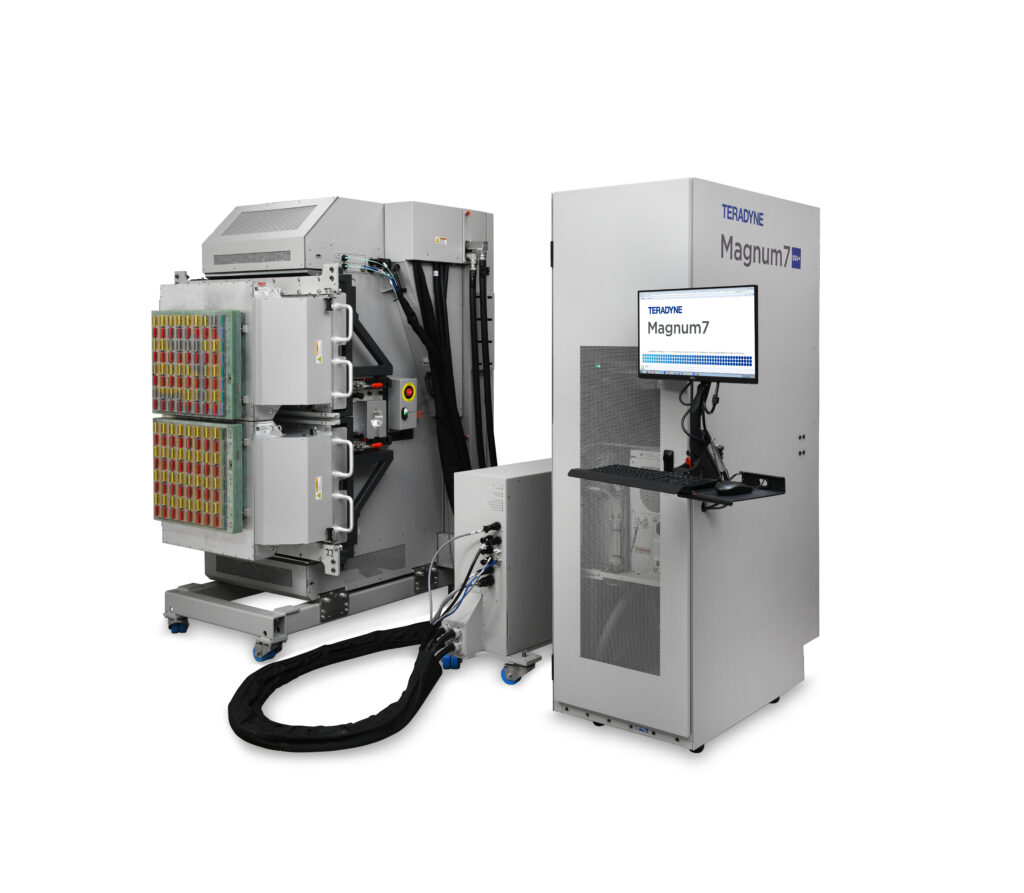
High Performance Flash Final Test for Today and Tomorrow
Teradyne’s Magnum 7 is intelligently designed to test the latest generation of NAND flash devices. High speed flash devices are enabling the next generation of UFS and PCIe applications. The AI revolution is fueled by massive amounts of data stored on high performance data center SSD’s and next generation AI PC’s, laptops and mobile devices. Magnum 7’s largest configuration delivers up to 18,432 I/O channels at 5.28Gbps per channel.
High Performance
With 5.28Gbps digital channels, Magnum7 is designed to test current and future generation NAND devices. With support for both ONFI and separate command/address (SCA) interfaces, Teradyne aims to meet performance requirements for years to come.
High Parallelism
The Magnum 7 GV can be configured for up to 18,432 I/O’s, up to 4,096 DUT power supply (DPS) channels and up to 4,096 high voltage (HV) pins. With Teradyne’s superior signal per volume efficiency, up to 1,024 devices can be tested at one time.
High Current PMU
Magnum 7’s massively parallel high current PMU enables measuring low resistance parameters in minimum time.
Scalable
The Magnum family of testers comes in a variety of configurations, all using the exact same hardware and software. The engineering focused EV supports as few as 4 tester sites. The mid sized SSV+ supports up to 96 tester sites, while the maximum parallelism GV supports up to 128 tester sites. Development work done on an EV can be deployed directly to a production SSV+ or GV.
Reduced Test Time
Teradyne’s proprietary Fail List Stream (FLS) combined with hardware accelerated parameter sweeping can reduce test time by up to 25%. The uniquely powerful and adaptable pattern generator employed by Magnum 7 combined with our application team’s proven track record of innovation delivers capability unrivaled in the memory test industry.
Magnum 7 EV
- Self- contained, low-power engineering test system, configurable with up to 1,152 digital pins and up to 256 DUT power supply (DPS) and high voltage (HV) channels.
- Tester interface units (TIUs) are available for mating to industry standard 512 and 768 parallel handlers.
- Device specific adapters (DSAs) and test programs are fully compatible across all configurations of Magnum 7.
Magnum 7 SSV+
- High volume production test system for final test applications, configurable with up to 13,824 digital pins and 3,072 DPS and HV channels.
- TIUs are available for mating to industry standard 512 and 768 parallel handlers.
- DSAs and test programs are fully compatible with EV and GV configurations.
Magnum 7 GV
- High volume production test system for final test applications, configurable with up to 18,432 digital pins and 4,096 DPS and HV channels.
- TIUs are available for mating to industry standard 512 and 768 parallel handlers.
- DSAs and test programs are fully compatible with EV and SSV+ configurations.
All Magnum 7 configurations, in fact all Magnum testers, share interoperable Teradyne test development and debug tools allowing seamless collaboration between different platforms. Test programs are written for a single device then cloned across the available hardware automatically, simplifying the development process. The suite of debug tools is also site aware, allowing isolation of a problem device quickly and efficiently, and smoothing the transition from new product introduction to high volume manufacturing.
Mixed-Technology Test Systems
Integrated Advanced Test Capabilities for Missile, Radar, Electronic Warfare, and Space Applications
Address complex test requirements of today’s advanced electronics with Teradyne’s integrated and scalable Mixed-Technology test systems – a single test solution that saves time, increases efficiency, and maximizes your return on investment.
Mixed-Technology Testing for Modern Aerospace and Defense Electronics
Modern aerospace and defense electronics have become highly sophisticated and increasingly integrated. Testing multiple technologies on a Unit Under Test (UUT) with mission-specific test systems is often inefficient and can lead to high cost of operation and maintenance.
Teradyne’s Mixed-Technology Test Systems address complex test challenges while offering a simplified, scalable, and cost-effective approach to testing in various manufacturing and product support environments.
Teradyne’s Mixed-Technology test systems are built on Teradyne’s standard, open architecture Spectrum test platforms, with integrated advanced test capabilities including:
- High speed digital bus tests
- Real-time storage and processing of high-bandwidth, streaming data
- Optical interfaces
- Complex digital/optical switching
- Precision analog
- RF instruments and subsystems
- High fidelity automated RF switching
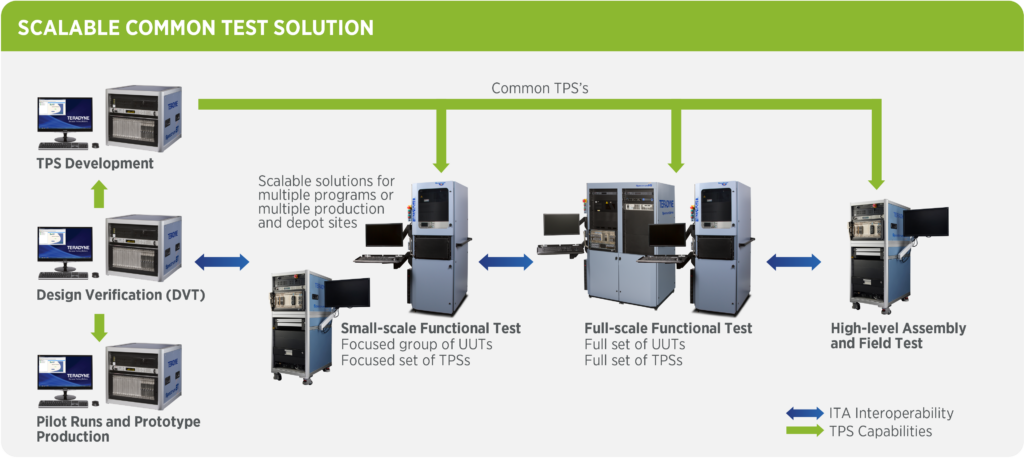
Teradyne’s mixed-technology test solution is highly scalable. System flexible sizing and compatibility across platforms provide cost-effective approaches to handling multiple programs at multiple production and depot sites.
Advantages
- Tests various advanced technologies with one test system
- Increases test and TPS development efficiency. Reduces procurement, operation and maintenance costs
- Reduces schedule risk and overhead cost with single trusted vendor
- Maximizes return on investment with system scalability and long-term supportability
- Teradyne can deliver Complete test solutions that solve any test-related problems
Scalable Test Solution for Mixed-Technology Test Applications
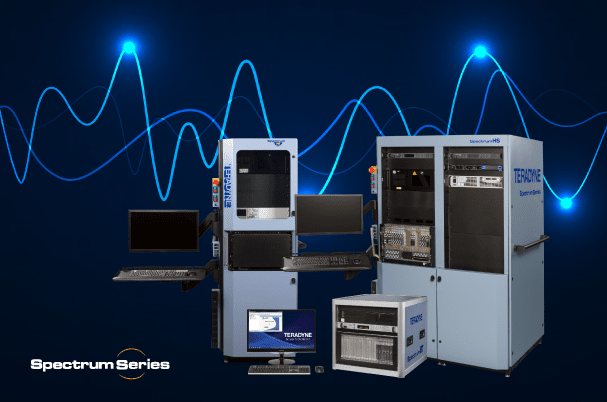
The Spectrum RF Systems are fully integrated, configurable test platforms combining several digital, analog, RF, and switching instruments to provide automated functional test solutions for a wide range of mixed-signal and microwave test applications including radars, Electronic Warfare, missile, and satellite communications.
Standard Instruments
- Teradyne’s software-defined, multi-functional eDigital instrument
- Teradyne’s high-performance ZT-Series analog instrumentation
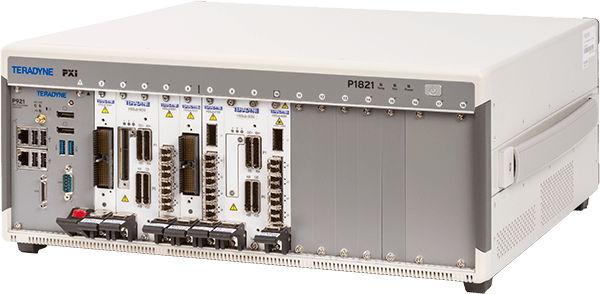
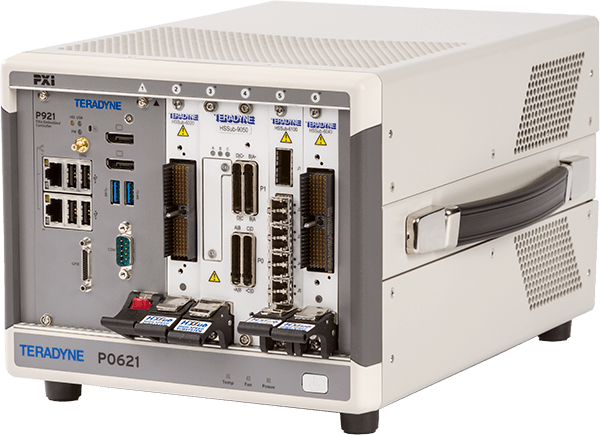
- Teradyne’s High Speed Subsystem foundation, ready for Teradyne’s full suite of high-speed PXI/PXIe digital and complex bus instrumentation
- Keysight Technologies’ industry-leading RF instruments
System Configurations
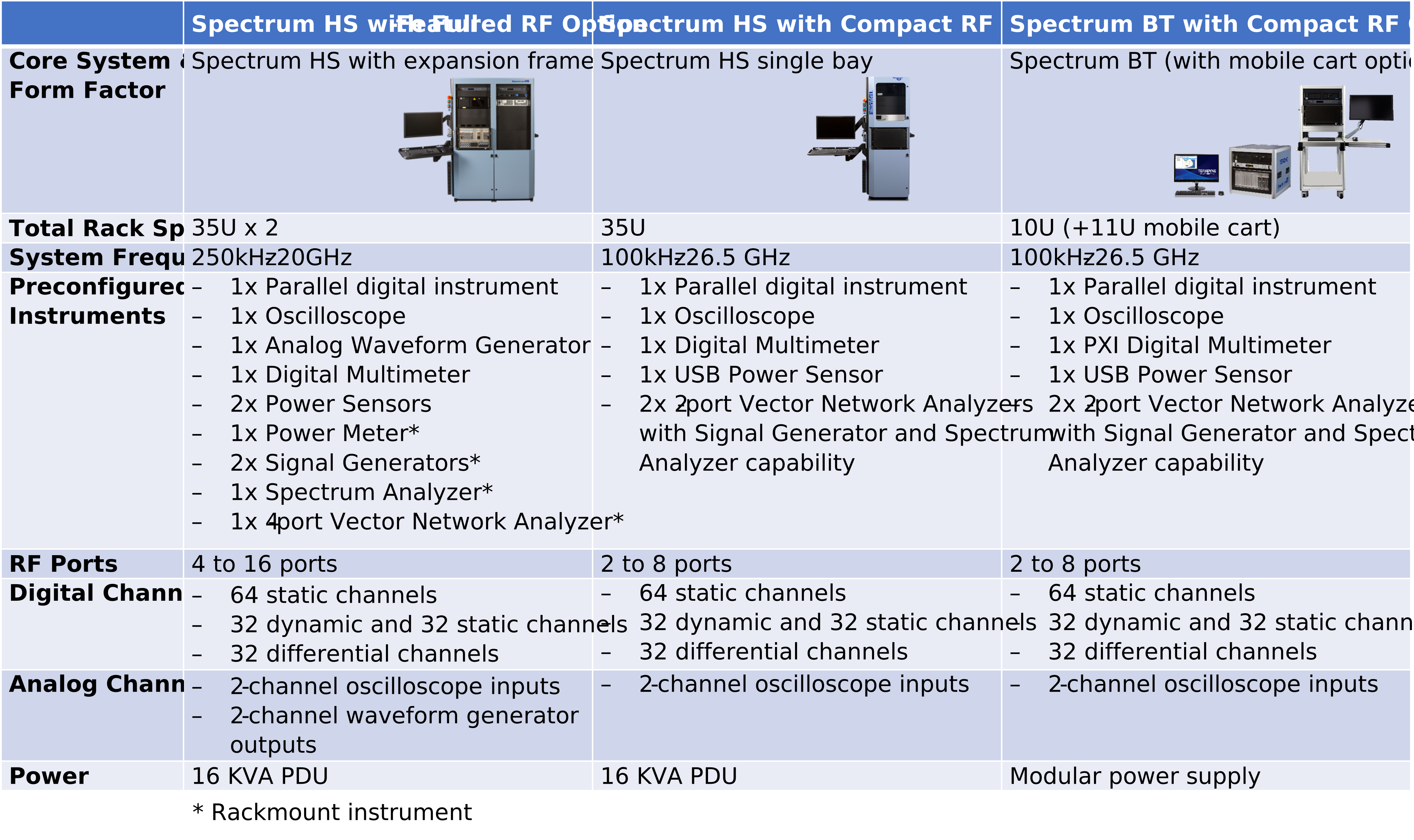
The standard Spectrum RF System configurations are optimized to support common test requirements for a mixed-technology Unit Under Test (UUT) with frequency range up to 26.5GHz. The platform’s flexibility, modularity, and open architecture allow the user to add test capabilities and configure the system to support unique UUT requirements.
Three standard configurations are available for different RF performance and form factor requirements.
Advantages
- Fully integrated standard solution with common RF, analog, digital test capabilities
- Proven performance, highly capable hardware
- Supports a wide range of test applications throughout product life cycle
- Highly scalable and expandable, ready to support future test needs
- Single trusted vendor with decades of test expertise and long-term support commitment
- Complete test solutions such as TPS and RFIU design, and TPS maintenance are available
Measurement Capabilities
Mixed-signal and microwave test applications up to 26GHz such as radars, Electronic Warfare, missile, and satellite communications. Measurement types include:
- Frequency Response
- Spectrum, Spurs, Harmonics
- Third Order Intercept
- S-Parameter
- Analog Modulation and Pulse Modulation
- Channel Isolation
- Digital Functional Test
- FLASH Programming
- Boundary Scan
- Analog Test
- Switching
Software-defined, Reconfigurable Solutions for High-Speed Digital Test Applications
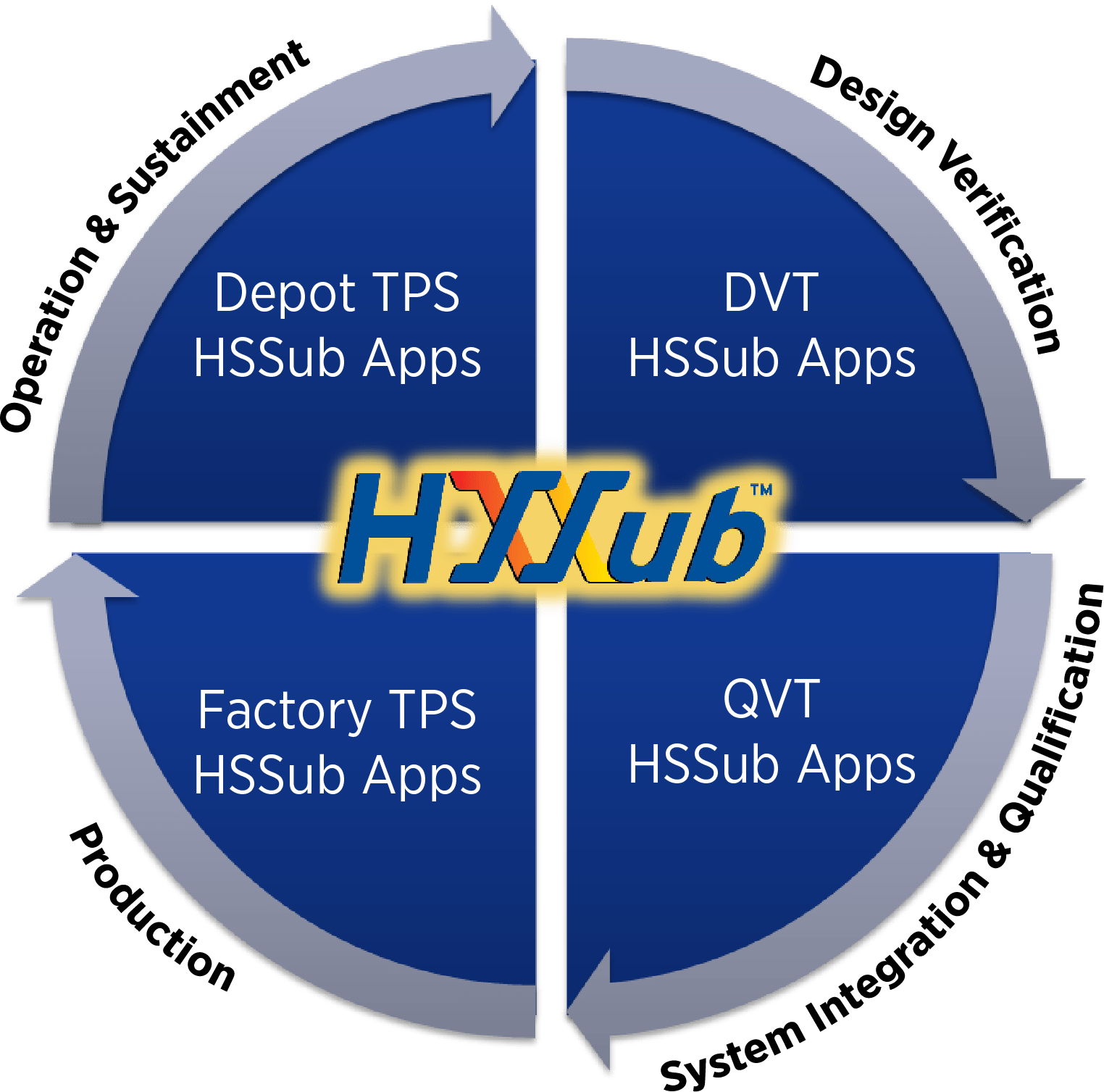
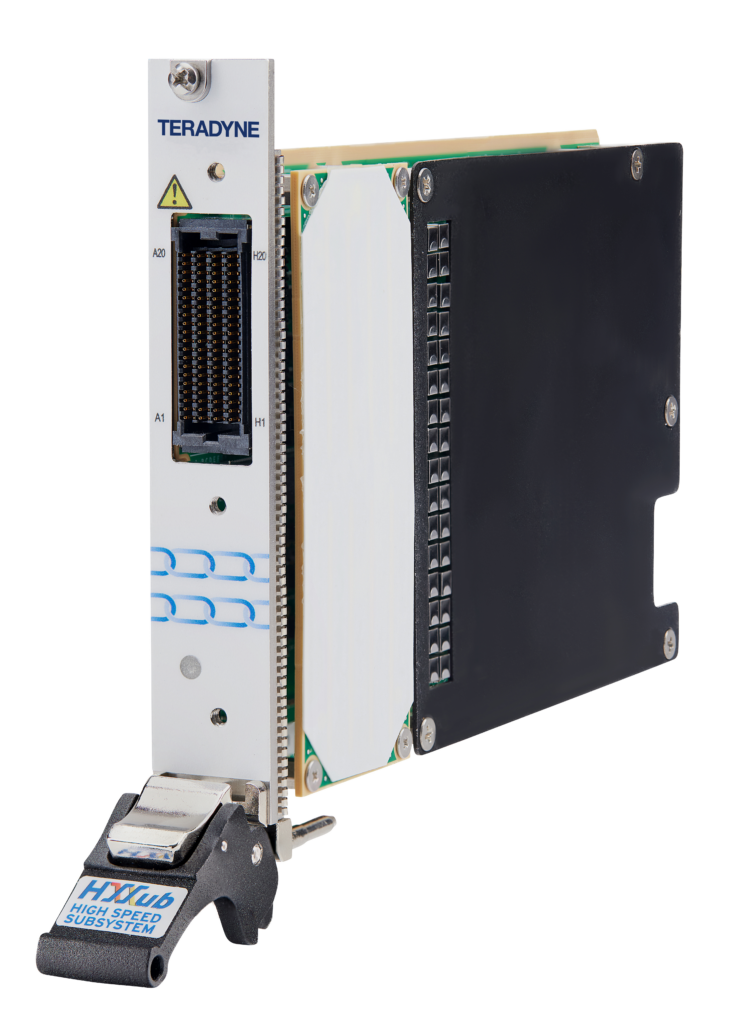
HSSub™ is a software-defined family of PXIe Instrumentation that can be integrated and scaled to support digital test applications throughout the product life cycle from design verification to production and sustainment.
HSSub instruments are configured via software, allowing them to easily adapt to test requirement changes and eliminate the need to add instruments to support system upgrades. The modular and open architecture enables equipment reuse, easy addition and expansion of test capabilities, and cost-effective long-term deployment.
Adaptive and Flexible Architecture Supports A Wide Ranges of Test Applications
HSSub architecture consists of three main components:
- HSSub Apps Software controls HSSub instruments and provides reconfigurable test functionality and programming API for test development
- HSSub TriFlex™ Software integrates and manages HSSub instruments and support modules while coordinating communication to the host test system
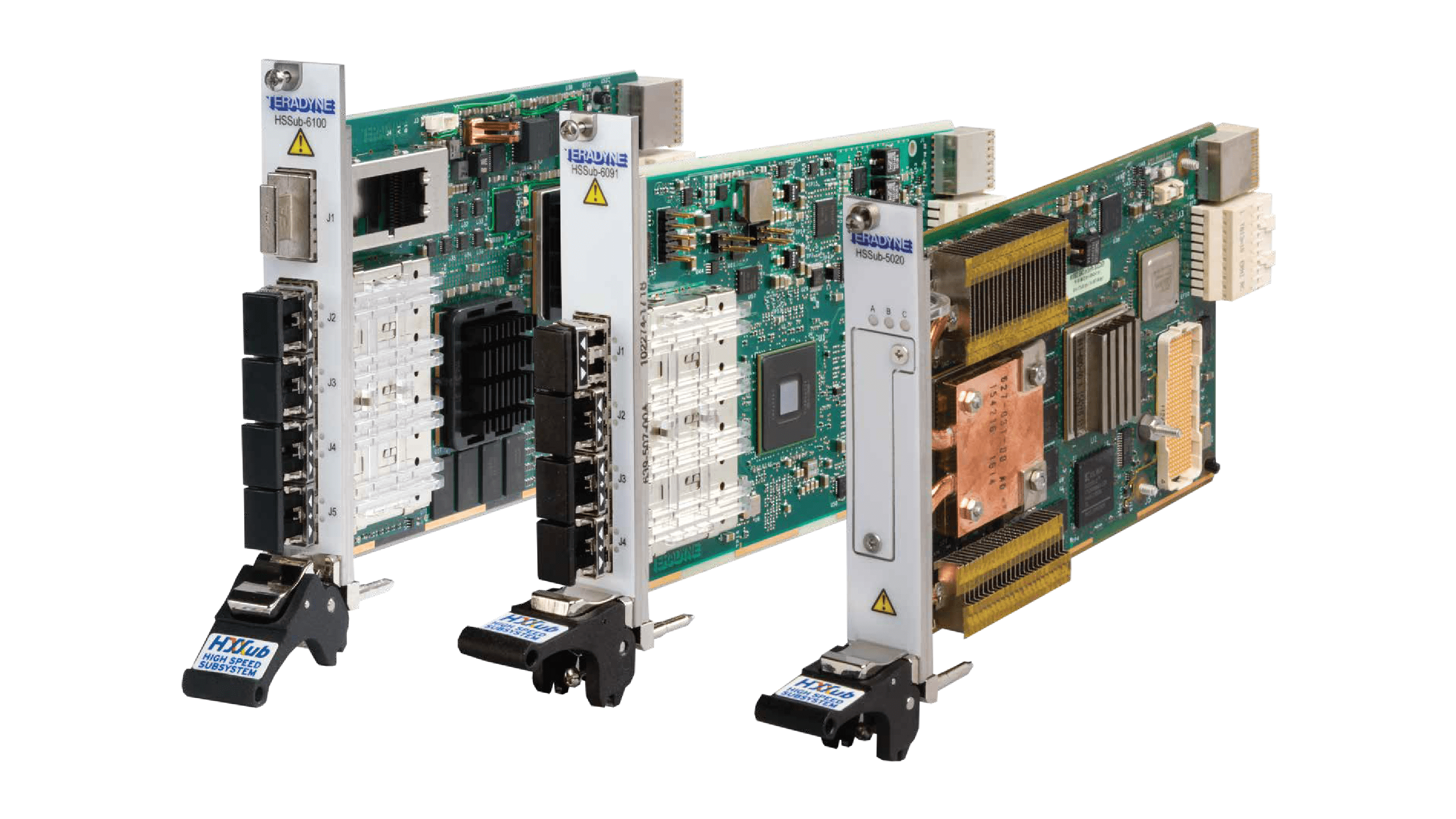
- HSSub PXIe Reconfigurable Instruments programmable via HSSub App software to support a variety of test requirements and configurations
This architecture allows HSSub to perform complex, high-speed and low latency test interactions with UUT as a distributed capability in a test system or as an autonomous subsystem.
The HSSub family of hardware and software provides a wide range of digital test capabilities, standard or unique, that can support many commercial and defense test applications such as AESA radars, communication network and switches, satellites, electronic warfare, missile guidance and targeting systems, streaming data, videos and displays.
>> View More HSSub Videos Here
HSSub Instrument and HSSub App
- Reconfigurable Instruments – Reconfigurable FPGA-equipped serial bus and parallel digital instruments
- Reconfigurable Flexible IO Instruments (FIOXI) – Reconfigurable FPGA-equipped instruments with flexible physical interfaces to support many different I/O types
- Standard Bus Instruments – Widely used standard serial bus instruments
- Support Modules – Additional hardware that provides extended test capability to the HSSub instruments, including real-time processing, optical conversion, data storage, and PXIe instrument use outside of the chassis.
- HSSub Apps – Software that defines HSSub instrumentation test applications
Supported Test Applications
- Dynamic Digital
- Boundary Scan tests
- Fast flash programming
- Streaming data test
- Optical switching and power control
- Video capture and pattern generation
- High-speed Serial up to 25 Gbps
- High-speed Parallel LVDS up to 800 Mbps
- Military bus emulation and test
- Fibre Channel
- SMPTE 292
- ARINC 818
- PCI
- PCIe
- SFPDP
- LVTTL
- LVDS
- I2C
- RS485
- RS422
- RS232
- IRIG-B
- PRBS
- ARINC 708
- HOTLink
- AS5643 FireWire
- Ethernet 10M, 100M, 1G, 10G, 25G
- USB
- eSATA
- MIL-STD-1553
- ARINC 664
- ARINC 429
- Teradyne offers test application development and training services. Visit Engineering Service and Total Test Solution to learn more
- HSSub App development tools are available for customers looking to build their own HSSub Apps for unique bus test
- Ruggedize Ancillary Kit for military ATS
- Factory automation supporting Environmental Stress Screening (ESS)
HSSub reconfigurable software-defined instruments provide endless test application possibilities and address rapidly evolving and emerging requirements
HSSub Apps leverage open architecture for TPS standardization and reuse, providing seamless transitions from test development to operation and maintenance
HSSub is modular, can be integrated into a system or subsystem and scaled to support all test phases of a product life cycle
HSSub’s proven reliability and Teradyne’s experience and commitment to long-term support assure cost-effective long-term deployment
Integrated Subsystem
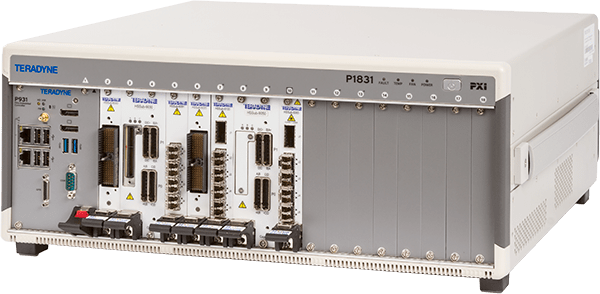
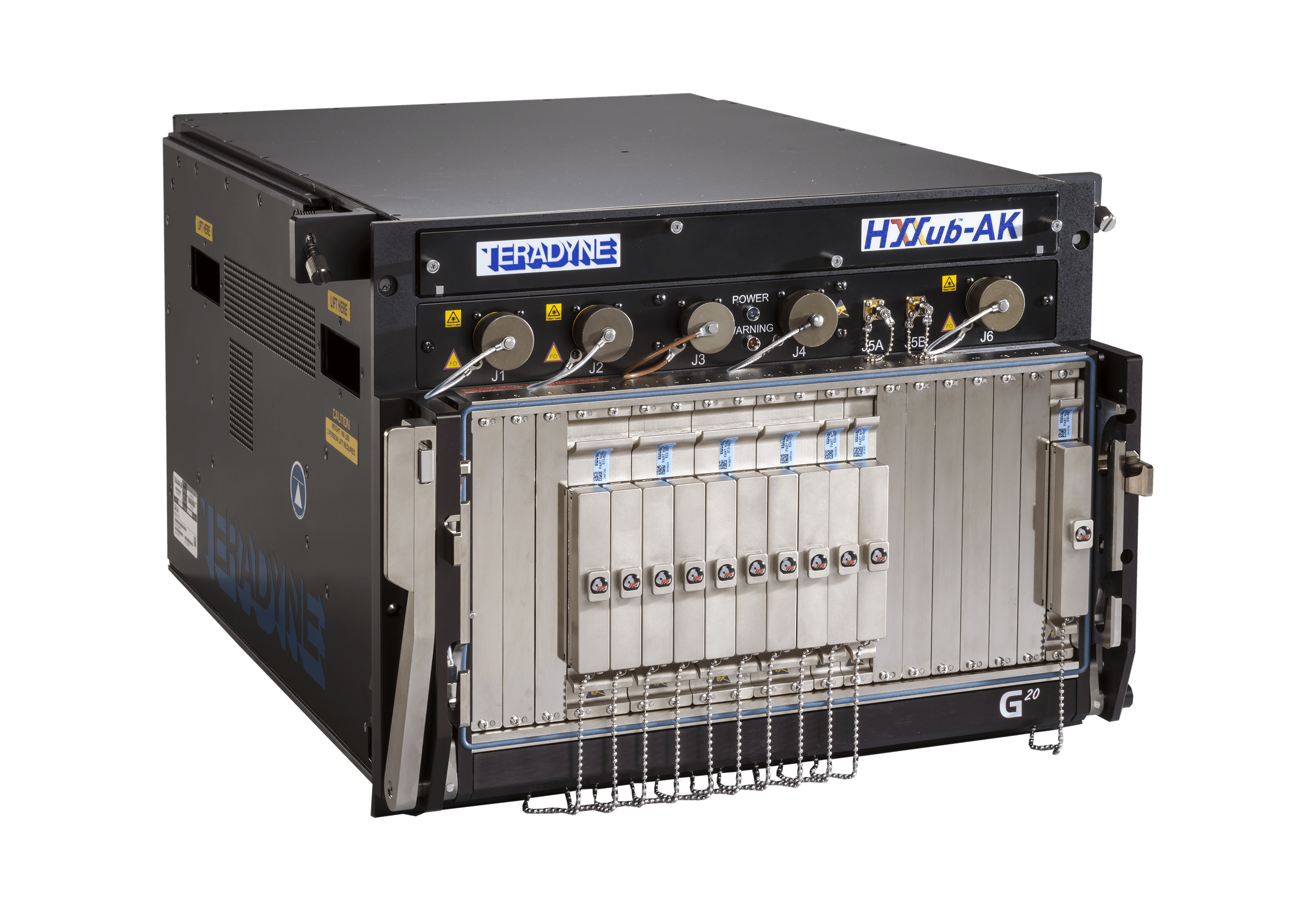
- 19-inch Rackmount with Virginia Panel G20 Interface
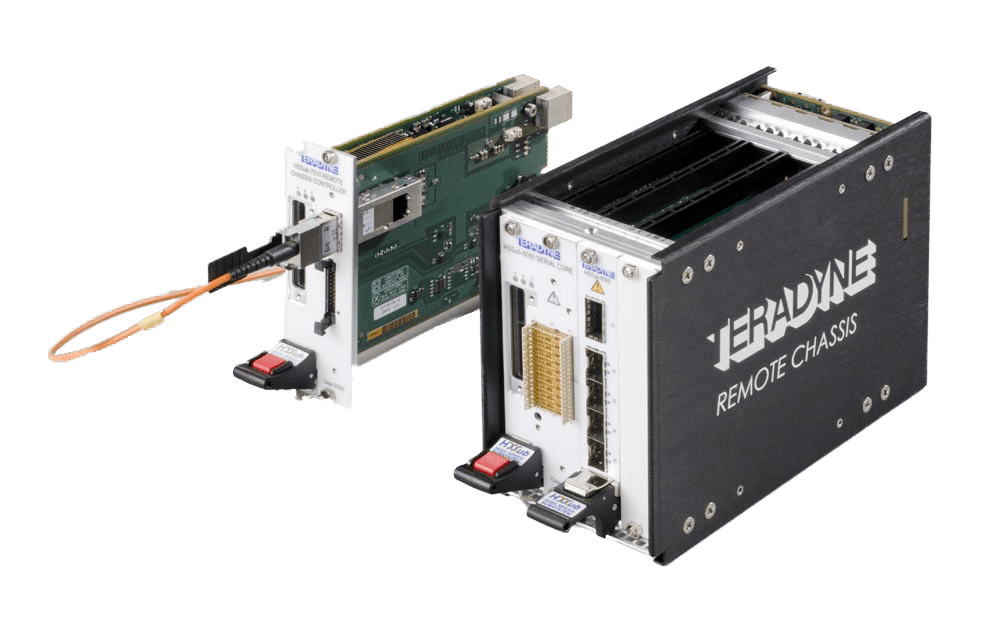
- HSSub Remote Test Head
- HSSub Optical I/O Interconnect
Ruggedized Subsystem
- Mil-spec Ruggedized Packaging
The ETS-200T discrete test platform is built on proven ETS technology and provides true index-parallel testing specifically for turret and rotary handlers. These test systems maximize throughput with pattern-based test techniques based on SmartPin™ technology coupled with the use of dynamic Cbits for enhanced user control. The ETS-200T provides a complete test solution from wafer sort to final test for MOSFETs, including integrated control and datalogging for UIL, dVSD, Qg and LCR meter.
Prewritten subtests help users avoid programming limitations commonly found in many discrete test systems.
Integrated with rotary and turret handlers for a complete final test discrete solution.
Integrated help file provides a detailed description of the test along with additional block diagrams and tool tips for optimizing test routines.
The ETS-200T test systems provide solutions with average site counts equal to or in excess of 16, with coverage of both DC and AC testing parameters. The robust software package combines pre-programmed routines for standardized tests with flexible programming tools for easy creation of customized tests. Completely integrated AC testing, including UIL Inductive Switching, Cg, Rg and Qg makes the 200T the ideal solution for both wafer and packaged device testing of discrete devices.
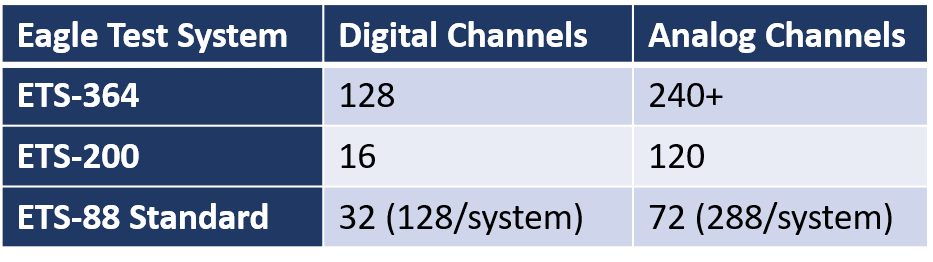
Platform scalability is key in the semiconductor test market, and ETS-200T test system uses the same floating analog resources as the ETS-88 product family and ETS-364.
DVI: digital V/I supports 16-bit voltage measurements up to +/-20 V with 0.61 mV resolution in 50us.
HPU-100: single channel V/I with 10 current ranges operating up to +/-100 V
SPU Family (100, 112, 500): suite of V/I’s capable of addressing a wide range of test requirements ranging from 100V / 2A to 500V / 50mA with fully AWG and digitizing capabilities per channel
Raptor includes a graphical user interface that allows fast programming and characterization with no language-based programming required. This innovative user interface allows users to directly input test conditions for a particular test and place the test in a user defined test flow. The pre-programmed test routines provide simple and easy to use methods for test programming that help users avoid programming mistakes and overcome limitations commonly found in many discrete test systems. The Raptor FT software suite increases test development productivity.
As the leading provider of complete Test Cell Solutions and services, we at Teradyne leverage our expertise, experience, and technology leadership to help our customers achieve the highest yield and the highest throughput in production with the fastest time to market. We partner with you in your journey from design to production to provide standard and customized test cell products and services.
eDigital-Series™ Digital Test Instrumentation
PXIe digital instrument supporting parallel digital testing for LVDS technologies.
Defense and aerospace boxes and board designs frequently use low voltage TTL (LVTTL) and/or low voltage differential signaling (LVDS) technologies and often require boundary scan and parallel I/O flash programming test capability. eDigital-Series instruments provide flexible, parallel digital functional test for units under test (UUTs) employing logic voltages between -2V to +6V.
Teradyne’s eDigital IVI driver controls all parallel digital functional test parameters, including per-pin timing and voltage levels, data formats, pattern data, and timing alignment on 32 channels with up to 16M pattern depth and results memory. Systems can achieve up to 544 synchronized channels using Teradyne’s Contact Free Air-Coupled Signal Technology (CFAST) using the newest instruments in the eDigital-Series.
eDigital-Series instruments also capitalize on the boundary scan, parallel I/O, and flash programming capabilities, which are often included on these newer UUTs. Packaged in a compact PXIe form factor, eDigital-Series instruments may be used as a standalone instrument or configured as part of an integrated HSSub system.
Superior LVTTL and LVDS digital test performance.
Its -2V to +6V digital channels feature 16MB pattern depth and results memory at up to 50MHz data rates across up to 544 single ended channels in a virtual instrument
Device programming via boundary scan and third-party boundary scan support.
Supports JTAG, Asset, Corelis, and Acculogic boundary scan tools.
eDigital software driver.
Provides full control of per-pin timing, data format and deskew across 32 single ended channels which can be programmed using modernized digital test editor (eDTE)
PXIe form factor.
Compact form factor maximizes performance density while reducing test system footprint.
Reliability and survivability.
High-density packaging and strict quality control including shock and vibration testing ensure low mean time between failure (MTBF) in the most rugged shipboard and mobile environments.
Worldwide support.
Available support services include 24-hour repair-and-return of defective parts, hotline telephone support, comprehensive training and documentation, and in-field calibration verification.
The eDigital-Series instrument family features a host of critical test capabilities that cover a wide range of applications.
eDigital-Series applications include:
- Parallel digital test
- Single-ended and differential digital test
- Conventional, parallel I/O and flash programming via boundary scan I2C +SPI and PCI via HSSub App
eDigital-Series is available as a standalone instrument or as a member of the HSSub instrumentation family:
Configuration choices include:
- eDigital-6030
- eDigital-6020A
- eDigital-6025A
- HSSub-6020
- HSSub-6020 with funnel
- HSSub-6025
Additional Capabilities and Accessories
- Optional interface adapters and cables
- Optional extended warranty/advanced replacement service
Di-Series™ Digital Test Instrumentation
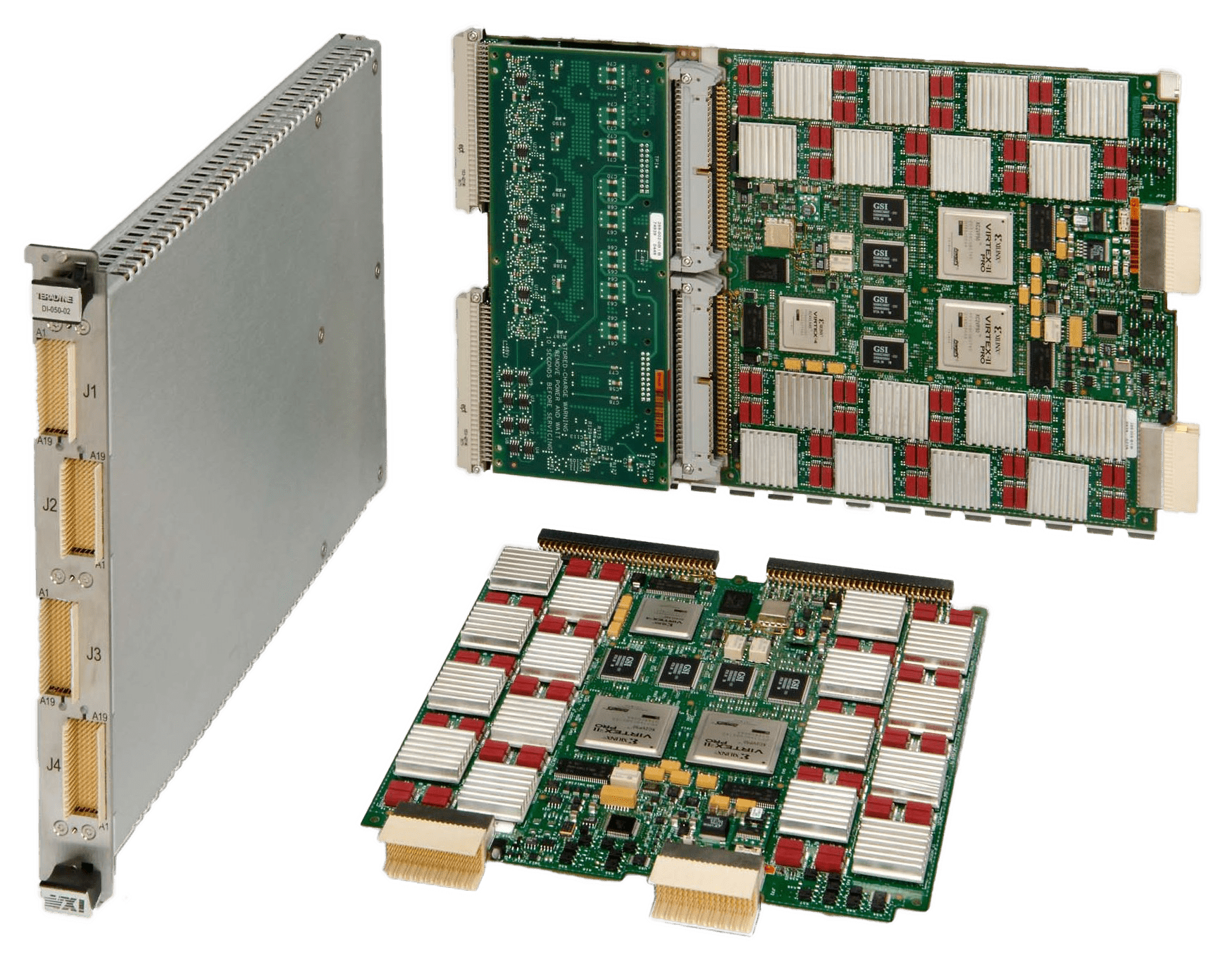
Integrated, standards based VXI instruments for digital test
Newer, higher performance defense and aerospace systems require increasingly rigorous digital testing. The VXI-based Di-Series multi-channel test instruments support these requirements with a powerful combination of performance, flexibility, usability, and reliability.
The Di-Series tests all levels of integration from board level (SRA/SRU) to box level (WRA/LRU) units under test (UUTs), while maintaining full compatibility with previous generations of Teradyne instrumentation and systems. Excellent usability and reliability reduce programming and support effort, as well as straightforward upgrades of existing test program sets (TPS).
Di-Series instruments are used in the U.S. Department of Defense (DoD) Standard automatic test system (ATS), U.S. Army IFTE, U.S. Navy eCASS, CASS, and RTCASS testers, U.S. Air Force VDATS, and Spectrum 9100 avionics test systems.
Superior performance.
Di-Series’ 50MHz speed, low voltage differential signaling (LVDS), and Quad-Detect™, which bands lower and upper limits of logic states, improve test quality, and decrease No Fault Found escapes.
LRU/WRA-Centric flexibility for bus-oriented digital tests.
Built-in capabilities, such as the Di-Series Handshake Engine, simplify asynchronous data transfer, improving test quality while reducing TPS programming time, complexity, and cost.
Unequaled usability.
Di-Series eliminates the need for shared resources with its independently programmed channels together with the iStudio™ graphic programming environment to speed TPS development and reduce cost.
Full compatibility.
Upgrade previous generations of Teradyne systems and instruments with the assurance that existing test programs are translated with proven TPS Converter Studio™ software.
Reliability and survivability.
High-density packaging and strict quality control including shock and vibration testing ensure low mean time between failure (MTBF) in the most rugged shipboard and mobile environments.
Worldwide support.
Available support services include 24-hour repair-and-return of defective parts, hotline telephone support, comprehensive training and documentation, and in-field calibration verification.
The Di-Series instruments feature a host of critical test capabilities that cover a wide range of applications.
Di-Series applications include:
- Parallel digital test
- Single-ended and differential digital test
- Memory test
- LRU/WRA test of new and legacy equipment
- M9-Series and L-Series replacement
Match Di-Series configurations to your current and future test needs:
Configuration choices include:
- Operating speed: 25 MHz or 50MHz
- Voltage range: ±15V or ±30V
- Channel count: 32, 48 or 64
Additional Capabilities and Accessories
- Optional interface adapters and cables
- Optional extended warranty/advanced replacement service
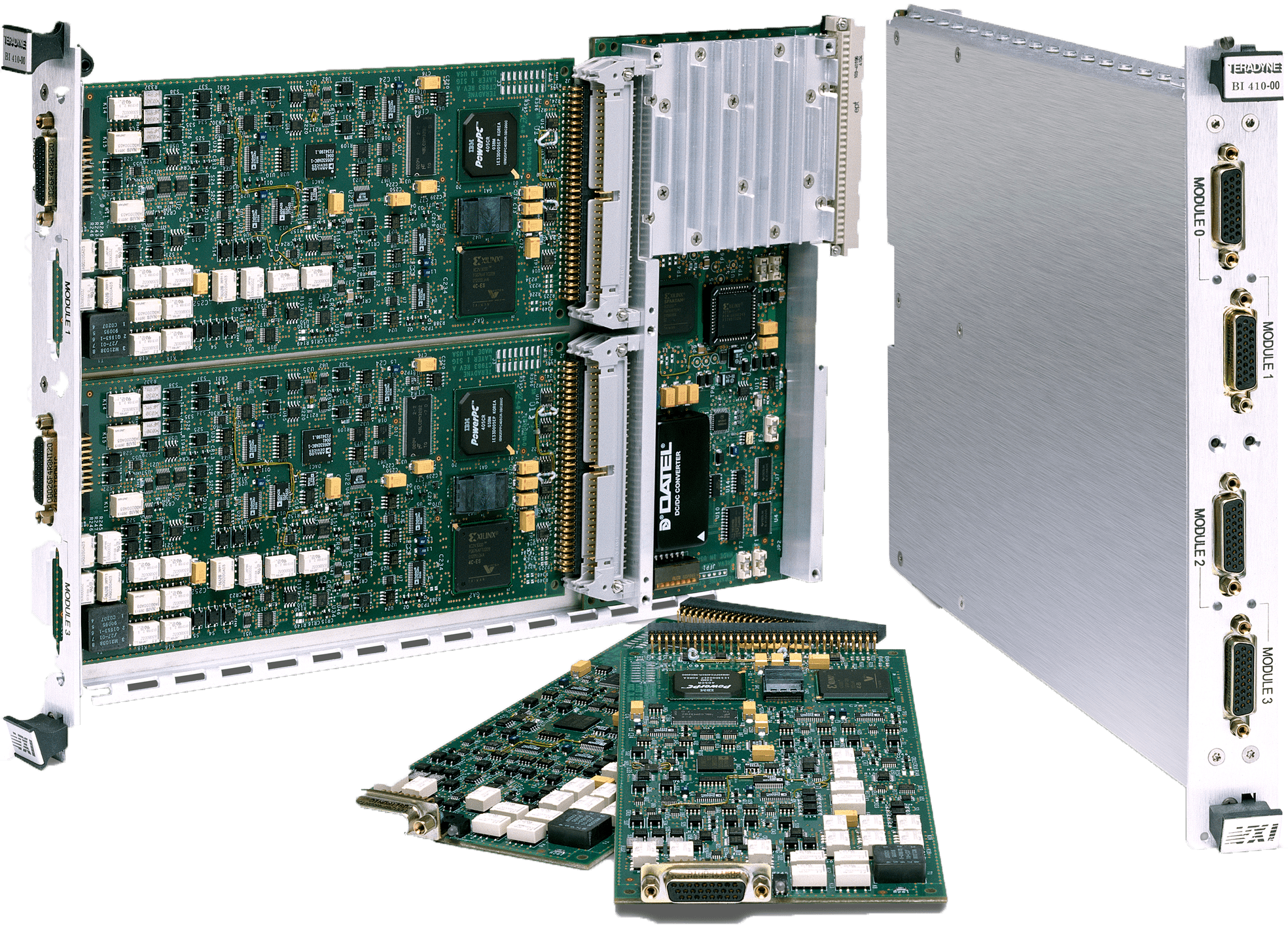
Multiple Module Serial Bus Test Instrument
COTS serial bus test instrument provides real-time emulation and test.
The wide variety of serial buses used in defense and aerospace applications typically requires multiple single-purpose instruments. Too often, they are difficult to reconfigure in order to test a different application.
The Bi4-Series provides all the capabilities needed for complete communications bus access test for up to four serial buses used in board level (SRA/SRU) and box level (WRA/LRU) equipment—all in a single VXI module.
The instrument includes test applications, industry-compliant software drivers and hardware enabling straightforward integration into automatic test systems.
With the configuration flexibility needed to effectively test every bus format used in defense and aerospace applications, the Bi4-Series instrument plays a key role in reducing implementation time and test system cost.
Synthetic Instrument Flexibility.
Test multiple standard and custom bus protocols using a single instrument.
Superior operational test.
Complete emulation as well as bus functional test capability increases UUT fault capture rate.
Emulates up to 4 buses simultaneously in a single VXI slot.
Lower acquisition cost and smaller footprint results in lower system integration cost, as well as lower TPS implementation and maintenance costs.
Straightforward upgrade capability
With its ability to address changing test requirements, the Bi-Series avoids test system obsolescence, resulting in reduced cost of long-term sustainment.
VXI plug&play™ software drivers supports C programming interface.
Reduces TPS development and maintenance costs with the fully supported C- programming interface that makes it easy to create new test models or modify existing ones.
Production-ready test equipment together with long-term Teradyne support.
Eliminating the problem of bus test obsolescence reduces test system logistics and maintenance costs—all supported by Teradyne’s decades of defense and aerospace test equipment expertise.
The Bi4-Series is the test solution for a wide variety of buses used in defense and aerospace applications.
Provides standard and serial bus protocol emulation and test for buses including:
- MIL-STD-1553 A/B
- ARINC 429
- ARINC 573
- RS-232
- RS-422
- RS-423
- RS-485
Multiple bus test capability
The Bi4-Series instruments are available in 2– and 4-bus modules.
Additional Capabilities and Accessories
- MIC bus and CAN bus capability
- Interface adapters and cables
- Extended warranty/advanced replacement service
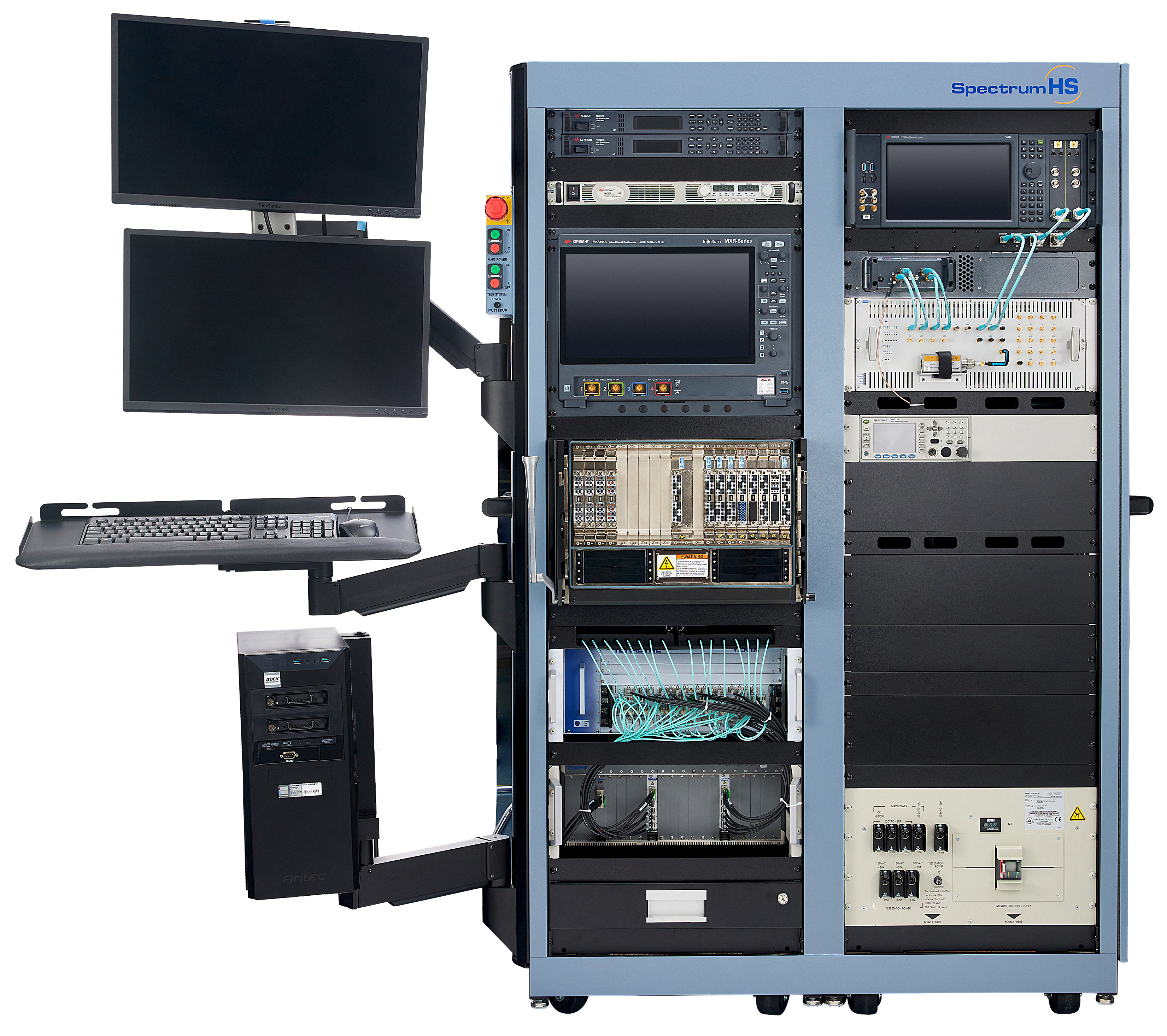
A Functional Test System Optimized for Real-Time Digital Bus Test
Defense and aerospace manufacturers and field repair depots face ever more rigorous demands for real-time test of boards, assemblies, and systems—especially new products in the development pipeline—that conventional testers can’t handle.
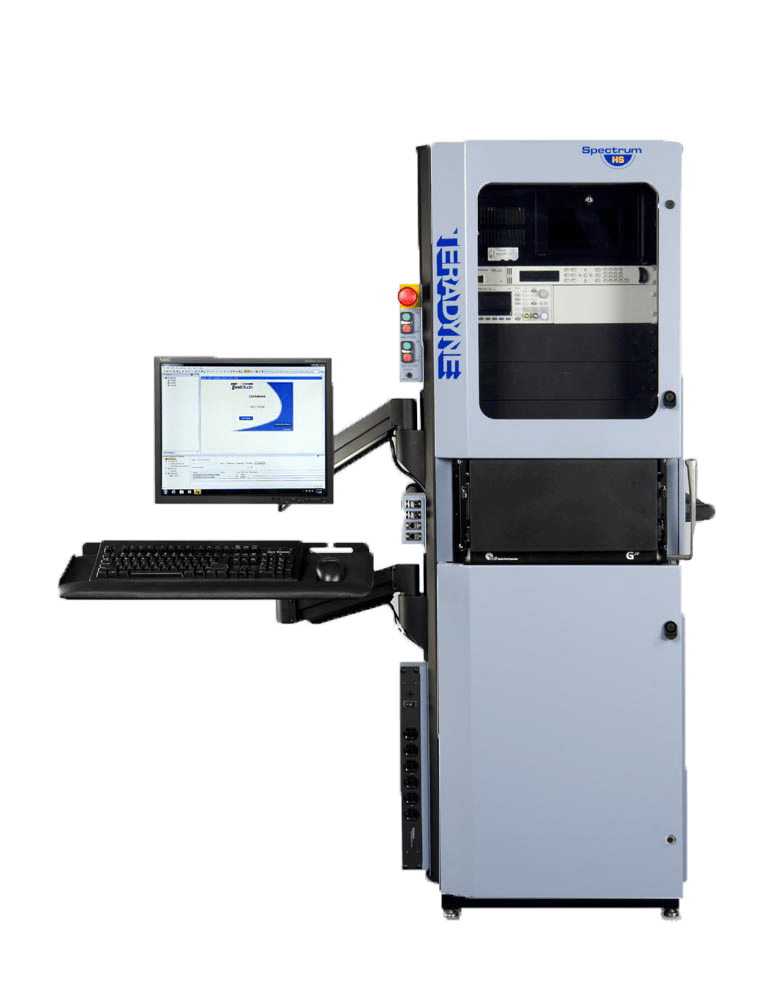
Spectrum HS is Teradyne’s fully integrated functional test system. Optimized for real-time test of low latency buses, it’s a high-performance system delivering excellent test coverage of current and future products.
Designed around PXI and LXI instrumentation, The HS system has the performance, flexibility, and completeness needed to meet formidable analog, digital, mixed-signal, and bus test specs.
Teradyne’s powerful hardware is accompanied by robust yet straightforward software tools that speed comprehensive test program set (TPS) development. More than five decades of Teradyne’s functional test experience are built into the Spectrum HS—the long-term answer to increasingly challenging high-speed test requirements.
Faster TPS implementation.
Spectrum’s proven PC-based software development suite reduces TPS implementation time and cost while increasing test coverage. Proven PC-based software development tools reduce test implementation time and effort with full QA by Teradyne of ongoing software releases..
A flexible, integrated test system.
Spectrum HS incorporates industry-leading test functionality, switching, software, self-test and calibration capabilities in a single integrated system that includes power distribution and thermal management.
Open architecture eliminates the threat of obsolescence.
Spectrum HS open architecture incorporates industry standards—PXI, LXI,
VXI, GPIB, IVI, Windows, ATML, safety, EMI—together with expandable size and power, providing straightforward modular expansion as test needs evolve.
High-performance bus test.
Spectrum HS is capable of real-time test of complex buses on boards, assemblies and systems—and is built for the increasingly complex, higher-speed digital buses on the horizon.
Benefit from Teradyne’s application experience and global support
Every Spectrum HS comes with Teradyne’s experienced applications expertise backed by a worldwide support and maintenance infrastructure that ensures rapid setup and implementation, as well as available next-day spare parts service.
Teradyne is here for the long run.
The international trailblazer in semiconductor, production, and depot test for more than 5 decades, Teradyne continues to be the leader in integrated functional test systems for defense/aerospace applications.
Spectrum HS system applications include:
- High-performance functional test for analog, digital and mixed boards, assemblies, and systems that incorporate high-speed, low latency busses used in products such as avionics, missiles, and vehicles.
- Real-time bus testing for today’s and tomorrow’s boards, assemblies, and systems.
- Performs in virtually every test environment including production test, depot repair of new and legacy products, including legacy rehosting.
The Spectrum HS system is available in a virtually unlimited array of configurations—from compact to large:
- Single bay through six bays
- Single-tier, double-tier and triple-tier interfaces (ICA)
- 6 KVA to 60 KVA input power
Spectrum HS features a broad range of options.
- High Speed Subsystem
- Serial, parallel, custom and standard bus support
- Unique three-tier architecture incorporates the advantages of simple field-programmable gate array instruments
- Real-time interaction with unit under test
- Fully integrated with other Spectrum-9100 instrumentation
- Switching
- Crosspoint matrix optimized for Di-Series and Spectrum Analog Instruments.
- High Bandwidth switch modules
- Switch management software
- VXI Instruments
Spectrum HS is designed to work with all standard third-party instruments, including:
- System level self-test
- Configuration of ICA cables
Software: Available support for third party software in addition to Spectrum HS standard software.
Focused Functional Test System
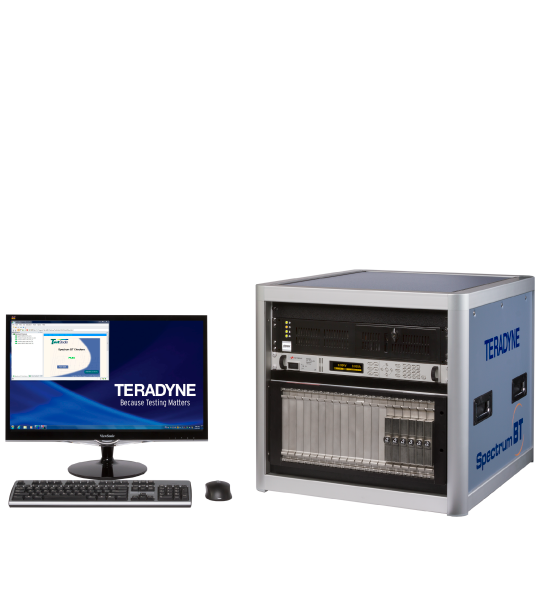
The Spectrum BT is a fully integrated PXI-based test platform optimized for testing a focused group of Unit Under Tests (UUTs). The Spectrum BT provides best-in-class functional test capability and configurability at a size and price that meets the needs of engineering labs, manufacturing facilities, and depots.
Compact, Cost-Effective Test Solution
- Compact solution with flexibility and configurability to support a wide range of test applications
- Standards-based and open architecture provides a vast number of options to meet the most demanding present and future test requirements
- Compact system fits on a workbench, with an expansion capability via a mobile cart to cover a range of applications
- Full compatibility with Teradyne’s Spectrum HS allows cost-effective scalability throughout your product life cycle
- Fully integrated, standard system includes system cooling, self-test, wire verification test, and an extensive documentation package
Typical Test Applications
- Focused test solution addressing a focused set of UUTs
- Common and scalable solution for multi-site and outsourced manufacturing
- Design Verification and system integration testing
- Troubleshooting faulty products
- Test Program Set (TPS) development
Configurations
- The Spectrum BT base system includes:
- Teradyne OEM PXIe chassis with controller
- 2U Computer
- 64-Channel 6020-Series digital instrument
- Modular power supply
- System self-test
System Options
Spectrum BT features a full range of useful options as well as numerous PXI/LXI instrument options to meet every test requirement.
Receiver:
- Full G20 receiver for mass interconnects
- Full G20X receiver for Spectrum HS compatibility
PXI/PXIe/LXI Test Instruments:
- Serial, parallel, custom and standard bus instruments
- Real-time processing and storage instruments for data-intensive testing
- High-channel count parallel digital instruments
- Precision Analog instruments
- Optical test instruments
- RF instruments and subsystems
- Standard third-party instruments
Switching:
- Digital/Optical switching
- RF switching or customer-specific RFIU
- Crosspoint matrix
- High Bandwidth switch modules
- Switch management software
Other Options:
- Mobile Cart
- Additional instrumentation space / Larger PXI chassis
- Higher power PDUs
- Work Surface
- Articulating swing arm for display
High-Performance Integrated Functional Test Platform
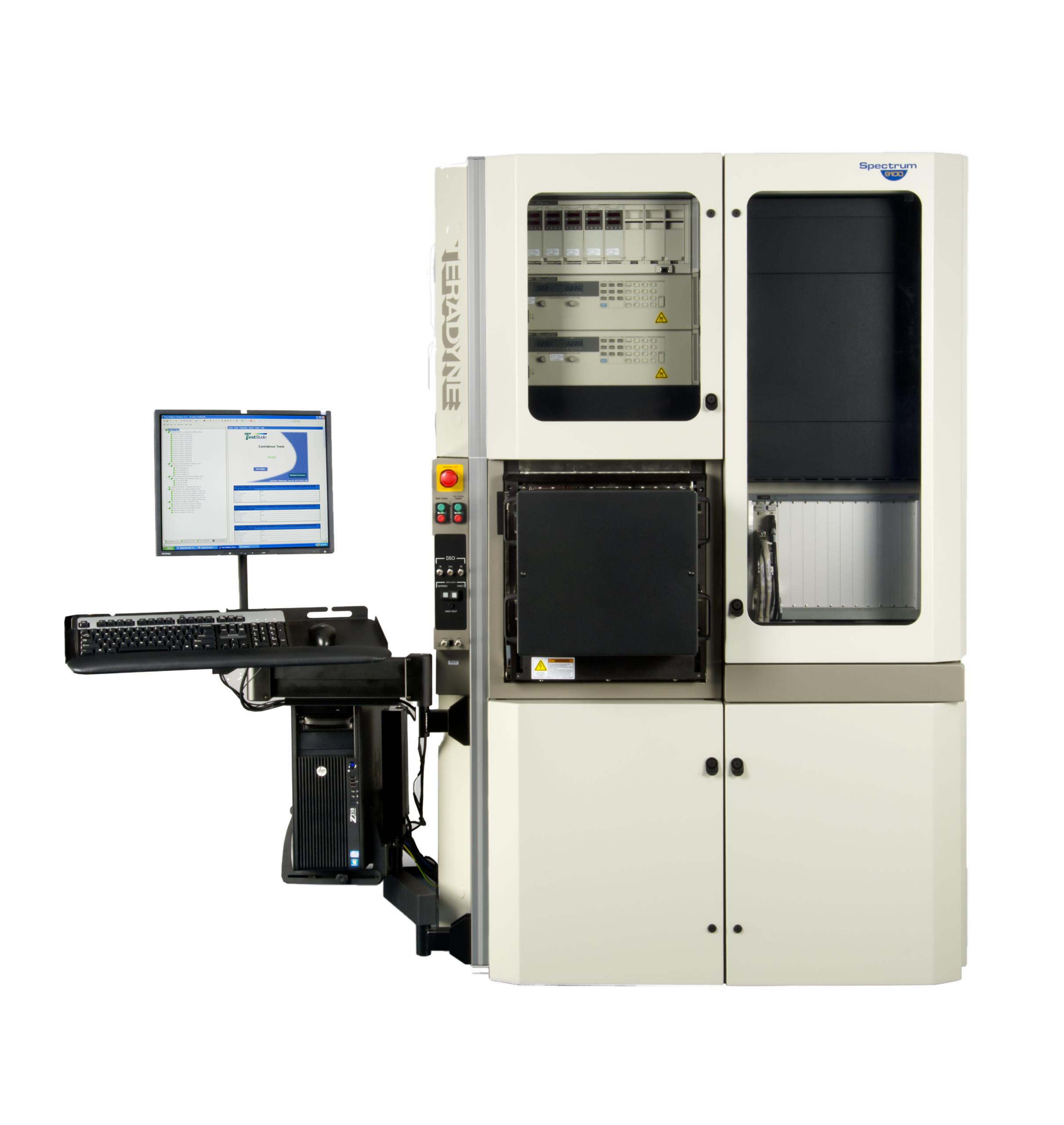
The Spectrum-9100 is a fully integrated functional test system for factory, depot, and intermediate test applications. It’s the “go to” tester for users needing a mix of digital, analog, mixed-signal, and bus test capabilities across a wide range of products—from legacy boards to advanced systems.
An open, standards-based hardware and software architecture consists of fully developed, fully documented building blocks. These deliver the flexibility and scalability needed to speed test program set (TPS) development and simplify maintenance.
The Spectrum-9100 is a cost-effective test solution—the field-proven defense and aerospace standard for high-performance functional test. More than 300 systems are currently in use worldwide in factories and depots, as well as commercial avionics maintenance and repair facilities.
Comprehensive digital, analog, mixed-signal, and bus test capability.
Spectrum-9100 is the choice of defense and aerospace product manufacturers and depots requiring a powerful yet flexible functional test system to verify, and/or diagnose a wide variety of future, current, and legacy products.
The defense and aerospace ATE standard.
Spectrum-9100 is the industry standard whose wide-ranging test capability that eliminates problems associated with UUT compliance and validation tests.
A flexible, integrated test system.
Spectrum-9100 packs industry-leading test functionality, switching, software, self-test and calibration capabilities in a single integrated system that includes power distribution and thermal management.
Open architecture.
Spectrum-9100 open architecture incorporates industry standards—PXI, LXI, VXI, GPIB, IVI, Windows, ATML, safety, EMI—together with expandable size and power, providing straightforward modular expansion as test needs evolve.
Faster TPS implementation.
Spectrum’s proven PC-based software development suite reduces TPS implementation time and cost while increasing test coverage. Proven PC-based software development tools reduce test implementation time and effort with full QA by Teradyne of ongoing software releases.
Benefit from Teradyne’s application experience and global support.
Every Spectrum-9100 comes with Teradyne’s experienced applications expertise backed by a worldwide support and maintenance infrastructure that ensures rapid setup and implementation, as well as available next-day spare parts service.
Spectrum-9100 systems are at work where defense and aerospace products are tested. Applications include:
- High-performance functional test for boards, assemblies, and systems used in defense/aerospace products such as avionics, missiles, and vehicles.
- Applications requiring analog, digital, mixed-signal, and/or bus test including performance digital test, parallel test, real-time bus test.
- Performs in virtually every test environment including production test, depot repair of new and legacy products, including legacy rehosting.
The Spectrum-9100 system is available in a virtually unlimited array of configurations—from compact to large:
- Single bay through six bays
- Single-tier, double-tier and triple-tier interfaces (ICA)
- 10 KVA to 60 KVA input power
Spectrum-9100 features a full range of options.
- Analog Instruments
- Bus Instruments
- Digital Instruments
- High Speed Subsystem
- Serial, parallel, custom and standard bus support
- Unique three-tier architecture incorporates the advantages of simple field-programmable gate array instruments
- Real-time interaction with unit under test
- Fully integrated with other Spectrum-9100 instrumentation
- Switching
- Crosspoint matrix optimized for Di-Series and Spectrum Analog Instruments.
- High Bandwidth switch modules
- Switch management software
- Third-Party Instruments
- Spectrum-9100 is designed to work with all standard third-party instruments, including:
- System level self-test
- Configuration of ICA cables
- Software: Available support for third party software in addition to Spectrum-9100 standard software.
High-Density Disk Drive Test System
The Teradyne Saturn™ HD is the industry leader in 3.5” Near-Line Hard Disk Drive (HDD) testing. It provides maximum throughput while minimizing factory floor space and power consumption. The system is designed to perform single insertion of SSW, BDSW and Burn-In as well as drive configuration. Using Saturn HD on the production floor will reduce drive build times, enable greater responsiveness to data center demands and lower test costs per HDD unit.
Offering the highest slot density per m2 in the industry, the Saturn HD can scale the number of test slots from approximately 4,000 to over 24,000 slots per system. Manufacturers using Saturn HD reduce the required factory floor space by 66% or more, versus a manual tester.
Teradyne’s automated HDD test solution provides optimized vibe control to test SSW and BDSW. This is a key feature to enable single insertion testing with burn-in and drive configuration. The system eliminates operator touch points, Work-in-Progress (WIP) and excess material on the test floor ensuring a very efficient test process. The end result is the highest throughput per m2 of floor space.
Power consumption is an important element of test costs. One of the biggest power consumers in back-end test is drive thermal control. The Saturn HD uses conductive heating strips for performing hot temperature tests that directly contact the drive rather than inefficiently having to warm air to raise disk drive temperatures. Within the tester, a unique closed loop cooling system is used to reduce the disk drive temperature to ambient for continued testing. This thermal control approach results in the lowest power consumption per drive slot in the industry.
In addition, the Saturn HD offers a beneficial capability for testing individual drive models in each slot due to the asynchronous operating architecture of the system. This provides manufacturers with product mix flexibility while maintaining peak throughput.
Highest test slot density per m2 of the factory floor (3x over manual testers) – eliminates the need for multiple new factories
Highest through put per m2 of the factory floor
Efficient test process eliminates operator touch points and reduces drive lead time and WIP via ability to support single insertion of multiple test steps, including SSW and BDSW
Reduces power consumption per HDD tested
Per DUT thermal control and data collection
Asynchronous test slots can run individual drive models in each slot for total flexibility and optimized throughput
- Back-End high volume manufacturing test for 3.5” HDDs in a single insertion
- Tests helium-filled and air-filled drives used in Data Centers and Hyperscalers around the world
- Supports both Windows and Linux operating systems
- Executes customized test scripts via the system Applications Programming Interface (API)
- Provides serial data System Management (SM) Bus or Universal Asynchronous Receiver Transmitter (UART) interfaces
- Multi-temperature testing from ambient to +85°C
- SSW and BDSW test capability in a single insertion
- Extendable to interface with factory automation
- Customizable data collection
- Can support both WIN and Linux
- Run customer test scripts via system API
- Serial data (SM Bus or UART) interface
- Ambient to +85C test range
- Vibe control for sensitive SSW and BDSW tests
- Power per slot to per slot drive power control
- Factory Automation friendly
Based on customer applications, need to contact sales for information
Test System Optimized for High-Performance Digital and SoC
Delivering superior economics and fast time to market with the industry’s highest rated software, the UltraFLEX test system has the power and precision you need for complex SoC devices. Choose UltraFLEX when your device mix and throughput goals demand the highest speed, precision, coverage and site count.
Superior Flexibility, Throughput & Scalability
The UltraFLEX scales from low pin count, analog-dominant devices to massive parallel test of high-end processors with superior parallel.
Maximum Test Quality and Yield
The UltraFLEX’s performance allows integrated circuit producers to meet the conflicting goals of “zero” defect rates and maximum device.
Faster Time to Production
Teradyne’s IG-XL software speeds time to market and reduces cost of test by transforming test program development.
- Mobile Application Processor
- Digital Baseband Processors
- High Data Rate RF Transceivers
- RF Connectivity Devices
- mmWave
- 5G
- Mobile Power Management ICs (PMIC)
- Microprocessors
- Network Processors
- High Speed SERDES (SERializer/DESerializer) and Backplane Transceivers
- Storage Controllers
- High-end Microcontrollers
- Audio and Video Processors
The two available UltraFLEX base systems allow customers to optimize capital cost and floor space, and maximize resource count. All three versions will accept the same device interface boards (DIBs) for application portability and use exactly the same instrument options for the most effective capital reuse and production flexibility. All heads feature a universal slot architecture, which allows any instrument to be installed in any slot.
The UltraFLEX test heads utilize SureMate® connections to the DIB which provide easy system reconfiguration and optimum instrument performance at the applications interface. Liquid cooling of high-density instrumentation also guarantees consistent hardware performance and increased reliability.
UltraFLEX-HD
12-slot system
UltraFLEX-SC
24-slot system
The UltraPin1600 high density, high speed digital provides 128 or 256 channels per instrument with test coverage up to 2.2Gbps. The UltraPin1600 implements Teradyne’s ground-breaking multicore, hardware-based Protocol Aware capability that allows individual pin groups to be saved to device data rate and timing and eliminates the need for digital patterns for programming standard data busses.
Proprietary hardware for same-cycle source synchronous capability and “walking strobe” timing measurements provides production test capability for high speed DDR and other critical applications when needed. The UltraPin1600 is also test program compatible with the earlier UltraPin800 and HSD1000 digital options.
The UltraPAC80 high density AC source and capture instrument offers up to 8 source and capture channels, each with dedicated audio and video analog paths. Teradyne’s proprietary sample clock architecture provides the user with complete sample frequency flexibility without performance compromise and guaranteed phase alignment to every other instrument on every run of the test program to eliminate the need for job-specific calibration to achieve the phase balance required for the highest performance RF transceivers.
The UltraVI80 high pin count, high accuracy voltage and current option provides 80 independent pins of “3-in-1” capability. Each UVI80 pin is a true voltage or current (VI) source and measure instrument complete with ultra high-accuracy differential voltmeters and time measurement units available to each pin for complete, massively paralleled testing of mobile power management devices. In addition, UVI80 channels can operate in a special, low-droop voltage source mode that offers unmatched power supply noise performance for sensitive analog and RF applications. Finally, each UVI80 channel has an embedded high performance AC waveform source and measure capability for highly paralleled test of D/A and A/D converters embedded in complex SOC or microcontroller devices.
The UltraVS256 high density Device Power Supply (DPS) provides 256 independent channels per instrument to provide the massively paralleled capability required by low power mobile communications devices. The UVS256 also offers a clamp-based current source capability for device parametric testing. The UVS256 provides test engineers with the capability of programmable output bandwidth and full pattern setup and measure control that results in reduced DIB complexity and faster test times.
The HEXVS and VSM Ultra High Accuracy and Stability Processor Core Supplies improve performance and yield of complex processors by offering unmatched voltage accuracy and stability under load. This allows devices to be configured for maximum performance at lower voltages, increasing the value and yield of devices tested on UltraFLEX.
The DC30 and DC75 voltage/current supplies extend DC capability to 30 volts and 75 volts to address high voltage test requirements of of mobile power management and other devices. Like the UltraVI80, both options contain a precision differential voltmeter and time measurement capability.
The UltraSerial10G is a high-speed serial instrument that can test expanding serial bus technologies and replicates the device operating environment for optimal test quality at device limited test time with the highest possible throughput. This instrument has 20 differential drive and receive ports (40 channels/80 wires) per board, a frequency range of 42Mbps to 10.7Gbps with 426M drive/compare, and 1Gig capture memory, and includes pseudo-random bit stream (PRBS) hardware, and protocol aware testing support for PCIe. All of these features are designed to provide an efficient test methodology for SerDes bus testing.
The UltraWaveLX subsystem, available in multiple configurations, delivers emerging wireless protocol capabilities by seamlessly integrating LitePoint’s leading edge technologies within the UltraFLEX platform.
The UltraWaveLX-RF delivers 802.11be (Wi-Fi 7) testing capabilities, while the UltraWaveLX-UWB serves UWB testing conditions, and the UltraWaveLX-60G supports mmWave applications in the 60 GHz band. These configurations can be combined to deliver multiple cutting-edge RF test capabilities within a single test platform.
The UltraWave24 high port count RF options provide up to 96 universal, vector RF ports with carrier frequencies and modulation bandwidths to cover the most advanced cellular and connectivity standards. The UltraWave options offer accuracy and phase noise performance equal to or better than the highest performance bench equipment available, and integrate waveform sourcing and capturing onboard to eliminate the need for additional tester instruments. The UltraFLEX ESA software toolkit and UltraDSP option provide industry-standard modulation and demodulation tools running on up to 32 dedicated processing cores with automatic data download via a dedicated high-speed data bus for simple correlation to industry standards and the highest possible throughput.
Teradyne is the leader in RF/wireless device testing and has a large installed base of UltraFLEX test systems with the UltraWave24 RF instrument. As new devices for handset and base station applications are introduced using mmWave technology, Teradyne’s mmWave instrumentation has expanded in anticipation of testing demands.
The UltraWaveMX53, UltraWaveMX44, UltraWaveMX20-D16 and UltraWaveMX8 are Teradyne’s MX family of instruments for mmWave frequencies. These instruments extend the UltraWave24 capability for full test coverage of WiFi, LTE, Ultra-wideband and 5G standards for frequencies below 52.6 GHz. Existing UltraWave24 customers can upgrade their systems with a single slot instrument that does not require reconfiguration of the test system. They can continue to use existing device interface boards (DIBs) and production interface docking compatibility for their existing applications.
The MX family of instruments targets RF and IF interfaces for both 5G IF transceiver and 5G RF beamformer device coverage. And they support characterization and production device testing for probe, package, module and over-the-air applications.
A patented active thermal control within the instrument guarantees temperature stability to ensure that high-performance specifications are met in the engineering and production environments. The UltraWaveMX instruments also feature integrated power detectors which provide specification traceability. There is a dedicated low phase noise DUT reference clock operating from 100 MHz to 6 GHz to supply a precision reference clock for devices with integrated PLLs.
These instruments feature native 5G-NR modulation and demodulation test coverage with the integrated ESA toolkit using industry-standard waveform algorithms for waveform modulation and demodulation to simplify bench-to-ATE correlation.
The instruments provide dedicated mmWave frequency blind-mate coaxial DIB connections, which are designed to withstand the challenges of a production environment while providing the performance to source and measure high quality from 8 GHz to 53 GHz test waveforms to the device.
The award-winning IG-XL test software environment enables simple programming for fast test program development. Interactive debug displays integrated with the instrument hardware create an intuitive software system that minimizes training and speeds time to market.
The UltraWaveMX53 addresses the need to cover the 5G FR2 frequencies up to 52.6 GHz. The instrument provides unmatched performance over the full frequency range with fully integrated temperature stabilization and calibration features. The integrated synthesizer per channel architecture provides best-in-class phase noise performance that enables source and measure capabilities of modulated waveforms with unprecedent EVM performance.
The UltraWaveMX53 instrument is available in three configurations: -D16, -IF and -RF. Each of these configurations provide two channels and 16 ports that cover up to 53 GHz. The IF and RF configurations add two more channels with a total of 16 additional ports that cover up to 20 GHz and 44 GHz respectively.
Teradyne’s UltraWaveMX44 provides coverage from 24 GHz to 44 GHz. The available 32 mmWave ports on the UltraWaveMX44 significantly simplify DIB design. For greater site density, the system can scale to up to 128 mmWave ports, which is necessary for multisite testing that delivers the lowest cost of test.
The UltraWaveMX20-D16 is Teradyne’s lower frequency band instrument. It is also an extension to the UltraWave24 to provide additional test coverage up to 20 GHz. This frequency band targets devices that have WiFi-6, Cellular 5G, Ultra-wideband, and 5G-NR IF interfaces. Each UltraWaveMX20-D16 provides 16 mmWave ports in the test system with the ability to scale to 64 mmWave ports for high site count testing.
The UltraWaveMX8 adds mid-band RF test capabilities to support WiFi-6E & 5G test needs. Adding the MX8 as a 1-slot upgrade to any UltraFLEX system with UltraWave24 extends the frequency range to 7.5GHz. Up to 160 MHz of bandwidth is available for supporting 802.11 modulated tests, and 16 RF ports with 8 channels are provided for high parallelism and efficiency. The MX8 provides industry-leading WiFi-6E test capabilities with faster time to market, higher yields, and lower costs.
By utilizing Teradyne’s UltraWave instruments, semiconductor manufacturers can configure their test systems with the most cost-effective solution to test current and future generations of mmWave devices, enables faster time to market and higher product yields. The MX44, MX20, and MX8 extend the UltraWave24 capability for full test coverage of IoT, WiFi, LTE, Ultra Wideband, and 5G standards while maintaining full DIB and docking compatibility.
As the leading provider of complete Test Cell Solutions and services, we at Teradyne leverage our expertise, experience, and technology leadership to help our customers achieve the highest yield and the highest throughput in production with the fastest time to market. We partner with you in your journey from design to production to provide standard and customized test cell products and services.
Integrated solution for digital switching and fiber optics operational verification
VERTA is an integrated instrument that combines inline optical power management for optical parametric tests, together with a high-speed, digital switch matrix for concurrent optical and/or copper interconnections between multiple bus test instruments and UUT interfaces. VERTA enables reliable, error-free bus communication and interoperability for high-speed, optically networked military weapon assemblies to minimize costly intermittent and No Fault Found test results.
Configurations
VERTA is available in two configurations: an integrated LXI instrument and a PXIe 2-slot instrument.
The LXI configuration should be selected for test applications requiring 8 to 80 optical UUT I/O connections. It consists of a foundation chassis with modular I/O modules:
- Multi-Protocol Switch Module (Verta-3010) supports numerous SFP transceivers with optical or copper connections, multiple or single mode fiber that supports multiple bus protocols from 100M to 10G.
- Optical Power and Switch Module (Verta-3020) Adjustable power and repeatable measurement to detect faults across network operating range and compensate for ATE path loss.
- Wide-Range Power Module (Verta-5010) for optical-to-optical testing featuring extended range power attenuation across the network operating range
The PXIe configuration (Verta-P3020) is ideal for up to 4 optical I/O connections of switching and optical power management and can be installed in the same PXIe chassis as the bus test instrumentation it connects with. The PXIe VERTA provides a compact and scalable solution and can be expanded to up to 12 connections by bussing together instruments.
Rear maintenance Verta Foundations
- Verta-1004 (10 Gbps max., 4-slot)
- Verta-1007 (10 Gbps max.7-slot)
Front Maintenance Verta Foundations
- Verta-404 (4 Gbps, 4-slot)
Capabilities and Applications
VERTA Capabilities
- High-speed digital switching of optical or copper connections that supports multiple bus protocols over 100Mb/s to 10Gb/s
- In-line parametric test of optical transmitters and receivers to confirm operational requirements at factory test and depots, thus ensuring the interoperability of assemblies in network.
- Concurrent test of multiple buses on a single UUT, and parallel test of multiple UUTs.
Test Applications
- Next generation MOSA-compliant weapon systems with fiber optic connections and VITA 64 bus protocols such as Ethernet, Serial FPDP, and Fibre Channel.
- Newer weapon systems such as F-35, B-21, NGAD that use a fiber optic backbone to interconnect a distributed arrays of radar, video, sensors, data storage, displays, and processing units.
- Weapon system modernization upgrade platforms such as the F/A-18E/F, F-15 EX with fiber optic technology
- A wide range of supported buses and speeds (in both optical and copper) provides flexibility to replace most existing high-speed switches and eliminates redundant copies of test instruments
- Optical parametric test improves operational readiness of Weapon Systems, reduces number of bad assemblies in repair pipeline which in turn reduces overall UUT support costs
- Fully integrated solution reduces footprint and lowers acquisition cost as well as TPS implementation and maintenance cost
- Teradyne’s long-term support ensures long product life cycle and low ATE maintenance cost
High-Speed Digital Bus
Test Instruments
Teradyne and AIT instruments test legacy and newer digital buses.
The enormous variety of digital buses used in defense and aerospace applications requires comprehensive, yet efficient testing.
Teradyne and AIT COTS instruments meet these challenging bus test requirements for legacy and standardized buses, as well as evolving digital buses that have faster speeds, larger data volumes, and increasingly complex protocols requiring real-time test and emulation.
HSSub™ Instrumentation
HSSub PXI Express instrumentation and HSSub Apps are a family of high performance, reconfigurable, multi-purpose bus test solutions for concurrent asynchronous UUT digital bus interfaces that address rapidly evolving test requirements. They significantly reduce the long-term logistics costs caused by inflexible configurations and multiple point-solution bus test instruments.
HSSub Instrument Options
Bi4-Series Bus Test Instrument
The VXI Bi4-Series bus test instruments are a versatile COTS solution providing real-time serial bus test and emulation, including test applications for a wide range of existing serial bus protocols.
Bi-Series
AIT Test Instrumentation
AIT features a broad range of standard bus interface and test modules available in a wide variety of packages and software programming environments.
Avioncis Interface Technologies Instruments
Reduce cost of long-term sustainment.
Choose from a wide range of bus test and emulation instruments and software that precisely match current and anticipated test requirements with ongoing support from the leaders in defense and aerospace test equipment.
High density form factors: VXI, PXI, PCI.
Compact, high density instruments reduce system footprint and reduce overall cost.
Lower cost of ownership and equipped for future test capability.
As bus specs continue to evolve in speed, data volume, and complexity, a wide range of instrumentation from a reliable and experienced supplier avoids single-purpose bus test instruments or too-basic configurable instruments that complicate system integration, documentation, and lengthen TPS development times.
Resources & Related Products
Software-Defined PXIe Test Solution for High-speed, Advanced Digital Buses
Superior performance bus test instruments designed to address the unique functiona...
Portable data loaders, fleet management, avionics bus and network solutions